(Originally published in AMA Art Magazine)
Allison Glenn always lived on the Great Lakes as a child, either in Detroit, Michigan or Rochester, New York. Both cities are right across the water from Canada and a short drive from Toronto. She recalls visiting Toronto frequently on family trips while growing up. Now a renowned curator, having contributed to the Counterpublic Triennial, New York’s Public Art Fund, Crystal Bridges Museum of American Art, Prospect New Orleans Triennial and the City of Chicago’s Department of Cultural Affairs and Special Events, among others, she has been given a chance to reconnect with the city she so fondly remembered visiting when young, as curator of the 2026 Toronto Biennial.
When contemplating her curatorial approach, Glenn’s thoughts naturally turned to water, since her relationship to Canada has always been shaped by the rivers and lakes that connect it with the US. In light of current political realities, those same rivers and lakes could also be perceived as ruptures. That idea is expressed in the phrase “Things fall apart”, which Glenn chose for her theme. It is a phrase of warning but also acceptance, conveying both the inevitability of rupture and also the opportunity it presents. As she says in the following interview, “What if we find the weakness and say collectively that this is a weak set of beliefs? We do not have to fix it. Maybe it needs to stay broken. If we let those things fall apart and allow the fallacies to emerge, we can collectively build other worlds and other universes.”
The theme you have chosen for this edition of the Toronto Biennial is a line from The second coming, a poem by Irish writer William Butler Yeats.
It is, though I am referencing Chinua Achebe’s novel Things fall apart, the title of which is taken from the Yeats poem. The phrase was also used for the title of the Roots’ fourth studio album. Over time, across different locations, artists, poets, musicians and authors have used the phrase as an indicator of moments of intense unrest and violence. It feels that we are in that moment again, so I am picking up on this to remark on the times we are living in now. I was thinking specifically about rupture as a methodology, a generative force, a condition, and about artists who use rupture as an ontological tool, or as a way of understanding, but also as a site of possibility.
Yeats was a spiritualist. He used the phrase “things fall apart” in a ritualistic way, referencing pre-ordained, cyclical apocalypses. Are art biennials a form of ritual?
That is an interesting read that I had not thought about, because again the strongest reference for me is Chinua Achebe’s novel, rather than Yeats’s poem. The lesson that Achebe presents is to not lose oneself in the face of utter destruction. It is important to look at how Achebe quotes Yeats, as two of titles of the books in his African trilogy cite European authors and one Igbo proverb. I am learning that this citational style of titling is anchored to how the narratives unfold in each of the books. For him, it is a comment on a kind of presence and what it means to be speaking of a place, to a place and from a place. But gosh, ritualistic biennials. You have given me a tough question. When you say ritual, what do you mean?
Like ceremony, something people act out to add substance or regularity to life, or to connect a community of believers in the same unseen things.
Well, that is fantastic. I can respond to that. The art world is a set of beliefs, like money is a set of beliefs. There are things we believe in as a society, things we all agree to, then there are smaller subsets like the art world, which is a loose arrangement of people. Everyone’s art world is slightly different. It is not this singular thing. In this time, we are dealing with sets of beliefs that are really at odds with one another, especially in the United States under what has been an increasingly fascist regime that has defunded arts organisations, continually attacking free speech and knowledge. This might sound a little woo-woo, but I believe artists are truth-tellers, seeking a way in the world that perhaps is not what we have all agreed to. We are constantly trying to frame and reframe and understand and revise a different set of beliefs. We do that with every gesture. In terms of the biennial, I guess I am participating in the ritual of saying I am going to call this out. I am participating in the ritual of not being afraid of making a political statemen in a moment when so many things feel like they are untenable. This is the fourth biennial I have had the chance to work on, and the first one I have curated on my own. Biennials provide a different structure to engage. I think we keep doing it because we are looking for new models. Those of us in the biennial sphere believe in the power of the sublime a bit, like what it means to encounter something in a way that you might not have imagined it, or to be overtaken by an experience of close listening, learning, watching, smelling, experiencing outside of the confines of where we have been told art lives. The chance encounter is a big part of the ritual. The opportunity and challenge of seeing the entire biennial is part of the ritual, as is the opportunity, whether you are local or visiting, to see a city in a way that you might not have prior. On your journey to find a work you might come across the best falafel somewhere, or a really cute vintage store, or meet somebody who has the same kind of goals of seeing the work, of understanding it and allowing for the experience to happen. And sometimes it is about finding a coffee or a restroom, taking the train in the right direction. It is the ritual of participating in this conglomeration of sites and ideas, agreeing to something that does not have a clear and distinct outcome. There is a bit of chaos in biennials that we agree to. Chaos is a bit of the ritual. Maybe that is why we keep doing it.
Coming from Detroit originally — different city, different country — did you have a learning curve in preparation to curate the Toronto Biennial?
Absolutely. Being invited was a multi-tier process. At one point I was invited to write a letter of intent. I spoke very personally. I made it about an embodied experience of the region. I talked about crossing the border often, growing up in and around Detroit. I rarely lived more than a few blocks from the Detroit River and Lake St Clair. For a couple of years we lived in Rochester, New York, which was very close to Toronto. So I always lived on the Great Lakes as a child. On our family trips, we often went to Toronto and Montreal. We were close. So I did feel like I had a general relationship with Canada because of crossing the border so often. But I had not been to Toronto in a while. And a lot of the city had changed. I had to get to know the city again. I also worked with a national curatorial advisory, this group of six brilliant curators working across the provinces. They were so generous in opening up their knowledge of their regions to me, and suggesting artists to look at. I had the chance to visit their provinces, their universities and museums and do in-person studio visits with the artists. It was a chance to see the abundance of the prairies and the sunsets over Saskatoon, and the fact that Winnipeg has one of the largest and urban Indigenous populations in Canada; to take a ferry to Victoria in British Columbia from Vancouver. These experiences helped me understand Canada, another embodied experience of why artists might be working in a way, because I do believe that our environments impact us. Then last summer, I was at a cousin’s wedding and was talking to my mom and uncle. I learned that my great grandparents on my mom’s side came from Canada to Detroit. So this journey of understanding Canada has also been understanding my familial relationship to it. It has been this really fantastic opportunity to also learn a bit about myself as I am learning about the country.
How much input did you receive on your curation from the organisation that runs the biennial?
It was a dialogue, like many things are. I do not think anyone has carte blanche in anything in this field. It is important to remove that mystique. There are always parameters set forth. In this case, making sure the biennial is at least a third Canadian and there are more female identifying artists than male. That is something the biennial has always done. They also secured the art museum at the University of Toronto as the main site for the biennial, which was a bit of a relief to have a concentrated, focused exhibition in one space that could then interact with other satellite spaces. They also said that this year we would be working only with a partnership model, so we did not pursue sites that did not already have some sort of programming happening. So, an abandoned building was not in the cards for this edition. Then they introduced me to many curators and organisations and places they thought would be good. I got to know the curators and the organisations and the ways they were working and developed proposals for them to consider. In two instances, I co-curated. For the Royal Ontario Museum, the presentation of work is co-curated by me and Tandazani Dhlakama, and at Mercer Union the presentation of a new commission is co-curated by me and Aamna Muzaffar. But it is also a matter of engaging with the parameters and understanding how much you can push it. A curator is contributing to a larger arc of a project. Because the biennial is so young, I made a decision to not repeat any artists that had previously participated. The biennial, which is a not-for-profit organisation, was also very open to my idea of working outside of the greater Toronto area and to this idea of simultaneity and collaboration. I brought in a bunch of additional venues, including the Anchorage Museum, Times Square Arts Midnight Moment Program, as well as the sites around the Great Loop in the United States, which is this continuous series of waterways that circles the eastern part of the United States and part of Canada and connects to the Gulf of Mexico.
What is the Great Loop project about?
The first edition of the Toronto Biennial, which was curated by Candace Hopkins, Tyrone Bastian and Katie Lawson, laid the groundwork for waterways and relationships. That left some threads for me to pull on. In this region, the horizons of our lakes feel like oceans. They feel like sites of possibility. There are some indigenous epistemologies that consider the Great Lakes the internal organs of global waterways. So I am returning to this idea of waterways, but looking specifically at global waterways and suggesting that the Great Lakes and global waterways are a confluence. The Great Loop project is a collaboration with multiple artists and sites, as well as with Counterpublic Triennial and Medina Triennial, to have a simultaneous harvest at gardens around the Great Loop, working with seeds that would be specifically grown in all of the zones. The intention is that every garden we are participating with is going to plant the seeds, harvest them and share them with their community. The project asks at this moment, when we are dealing with increased nationalism and borders, how can seeds be a radical lens for ideas of exchange dialogue? One participating artist is Jean-Marc Bullet. He is based in Martinique, where pesticides were overused and something like 85 to 90% of the people have trace amounts of pesticides in their bloodstream. Amidst this, Jean-Marc has figured out a way to develop an organic garden. He and his partner develop teas and cacao and tinctures from what has been harvested in his garden. It is really beautiful. And again, he is an artist who is using rupture as a way of understanding accessibility of healthy food on an island that has been poisoned by the overuse of pesticides from banana plantations. Similarly, another artist in the project, Céline Semaan, has a slow forest in Nyack, New York. She keeps bees and has exhibitions, and hosts dinner parties with her partner and her family. Then there is artist Allana Clarke’s Amend Garden in Detroit. She is developing this garden in a food desert and thinking about how this kind of living artwork can address sustainability, food security, food safety and access to healthy, fresh food.
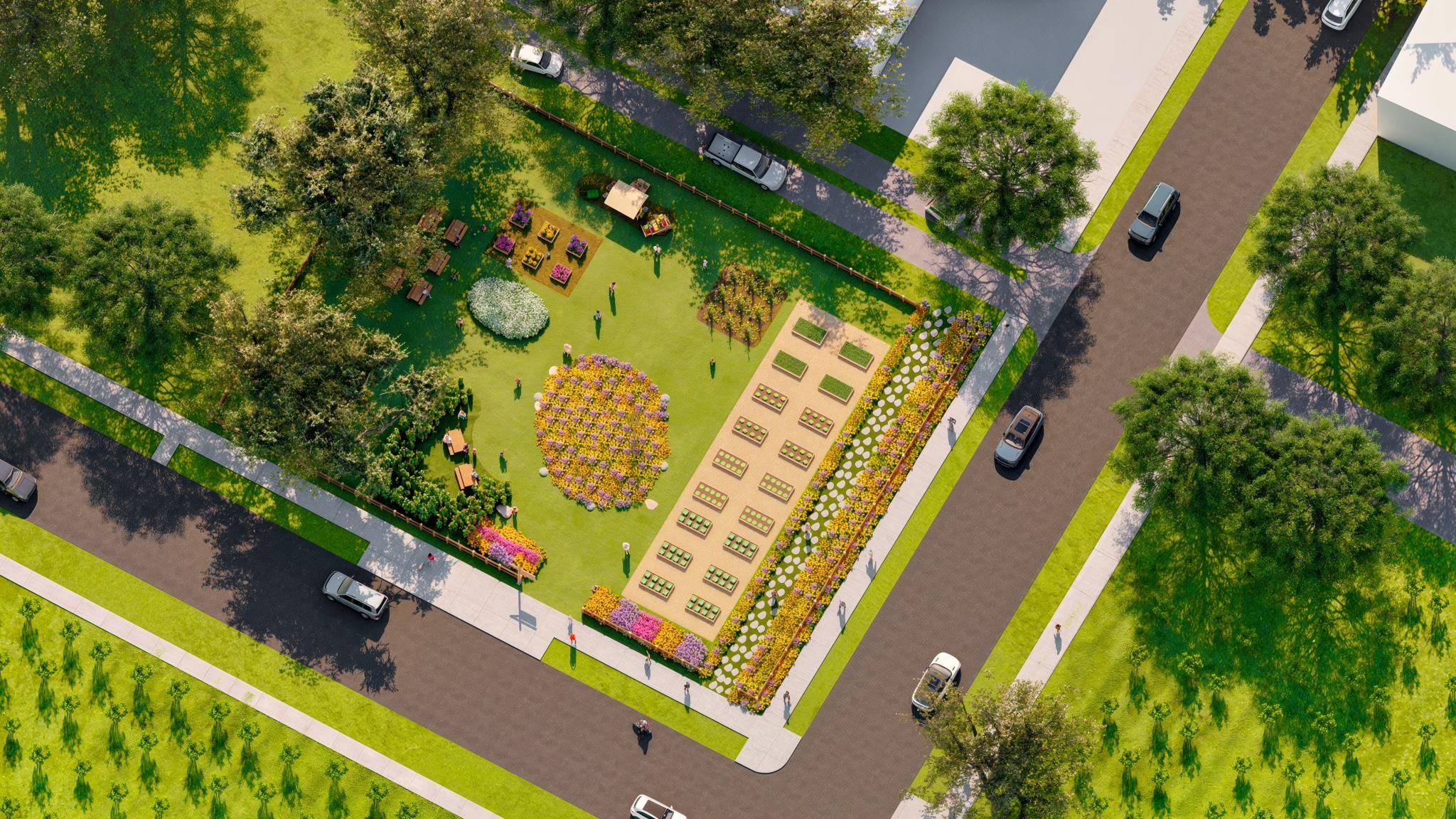
We have a main hub in Toronto as well. Then with Medina Triennial, we are collaborating with Mary Mattingly’s floating garden. And Counterpublic has a project site at the Antioch Baptist Church. They run a garden with Sumner High School and the produce in the garden goes directly to their food pantry. We are asking them all to document what they are doing with disposable cameras and notebooks. They will be telling the story of their harvest and that will be collected and exhibited. Then in Toronto at a convening we are holding in October, we are going to hopefully have tea from Jean-Marc’s garden that is sweetened by honey from Céline’s forest and taste some of the pickled items that have been grown by the Toronto Black Farmers and Fruit Growers Collective. We will taste things and drink tea and talk about the process together. But the meta narrative or meta frame is thinking about global waterways.
You are also collaborating with the National Gallery of Canada. Was that your idea, or was that in the works before you got there?
The Toronto Biennial has previously collaborated with the National Gallery of Canada and the relationship is one that the Biennial has stewarded quite diligently into this this edition. They partnered last year and my colleague Susannah Rosenstock led the charge on that this year. I am very excited about the outcome for the artist. He is able to realise his complete vision.
Going back to “Things fall apart” — it is a warning. But is it also hopeful? The Yeats poem has a line, “the falcon cannot hear the falconer”. It is a sign of distress, but also the falcon is finally free.
Wow, I want to sit with that for a minute. One hundred percent. We can agree that things fall apart. So we need to take a collective breath and just acknowledge where we are. Things are not okay. What is happening in the United States is not okay. What is happening around immigration and detainment is not okay. What is happening abroad around aggression and escalating violence is not okay. The genocides that are happening are not okay. To say something is not normal is liberating. Acknowledging that is the first step in seeing a path forward. Then we can pull back a bit with this idea of things falling apart. It is messy out there, things are dire, but there is a longer history of what is happening. Over a century people have been saying the same thing. It has been going on for along time, and maybe it will be going on longer than we are here. But what if we allow it to fall apart? What if we find the weakness and say, collectively, that this is a weak set of beliefs? I do not believe that for me to be satiated, someone else has to be hungry. I do not believe that for me to feel safe, someone else has to be threatened, or that violence needs to be used in the name of safety and freedom. I do not believe that in order to feel safe on a land, someone else or some other group of people needs to be removed from the land or feel unsafe. So yes, “Things fall apart” also allows for a hopeful theme. We do not have to have a Kumbaya moment. We do not have to fix it. Maybe it needs to stay broken. If we let those things fall apart and allow the fallacies to emerge, we can collectively build other worlds and other universes.