

(Originally published in AMA Art Magazine)
It used to be common for this or that artist to be declared part of the avant-garde. For various reasons, such declarations fell out of fashion and would be absurd to make today. What does it mean, anyway — the avant-garde? It was originally a military term for frontline forces in a war, those taking and dishing out the most vicious attacks. According to the National Galleries of Scotland, the term was first used to describe artists in 1825, “by French social reformer Henri de Saint-Simon” who “called upon artists to ‘serve as [the people’s] avant-garde’, insisting that ‘the power of the arts is indeed the most immediate and fastest way to social, political, and economic reform.’”
De Saint-Simon evidently considered human civilisation a battlefield. His society was also unapologetically patriarchal, so the first artists to receive his avant-garde label, Gustave Courbet and Jean-François Millet, were men, of course. They were both virtuoso realist painters, but it was not their medium nor the quality of their work that made them avant-garde — it was their subject matter. Instead of the popular themes of religion, wealth, power and romance, they centred peasants, farmers and the working class. That was controversial. It bucked convention. Avant-garde henceforth became synonymous with defying tradition. Impressionists were called avant-garde, as were Cubists, Futurists, Expressionists, Surrealists, Dadaists, Abstract Expressionists, Minimalists, Postmodernists — all the “ists”.
Meanwhile, the term’s inherent patriarchal militarism continued to determine who was allowed to be part of the avant-garde, namely straight (or at least closeted) caucasian men.
In 1978, that perspective was brilliantly challenged by artists Valerie Jaudon and Joyce Kozloff, in their essay Art Hysterical Notions of Progress and Culture. They wrote: “Manifestoes of modern art often exhort artists to make violent, brutal work, and it is no accident that men such as (Joseph) Hirsh, (Diego) Rivera and (Pablo) Picasso like to think of their art as a metaphorical weapon.”
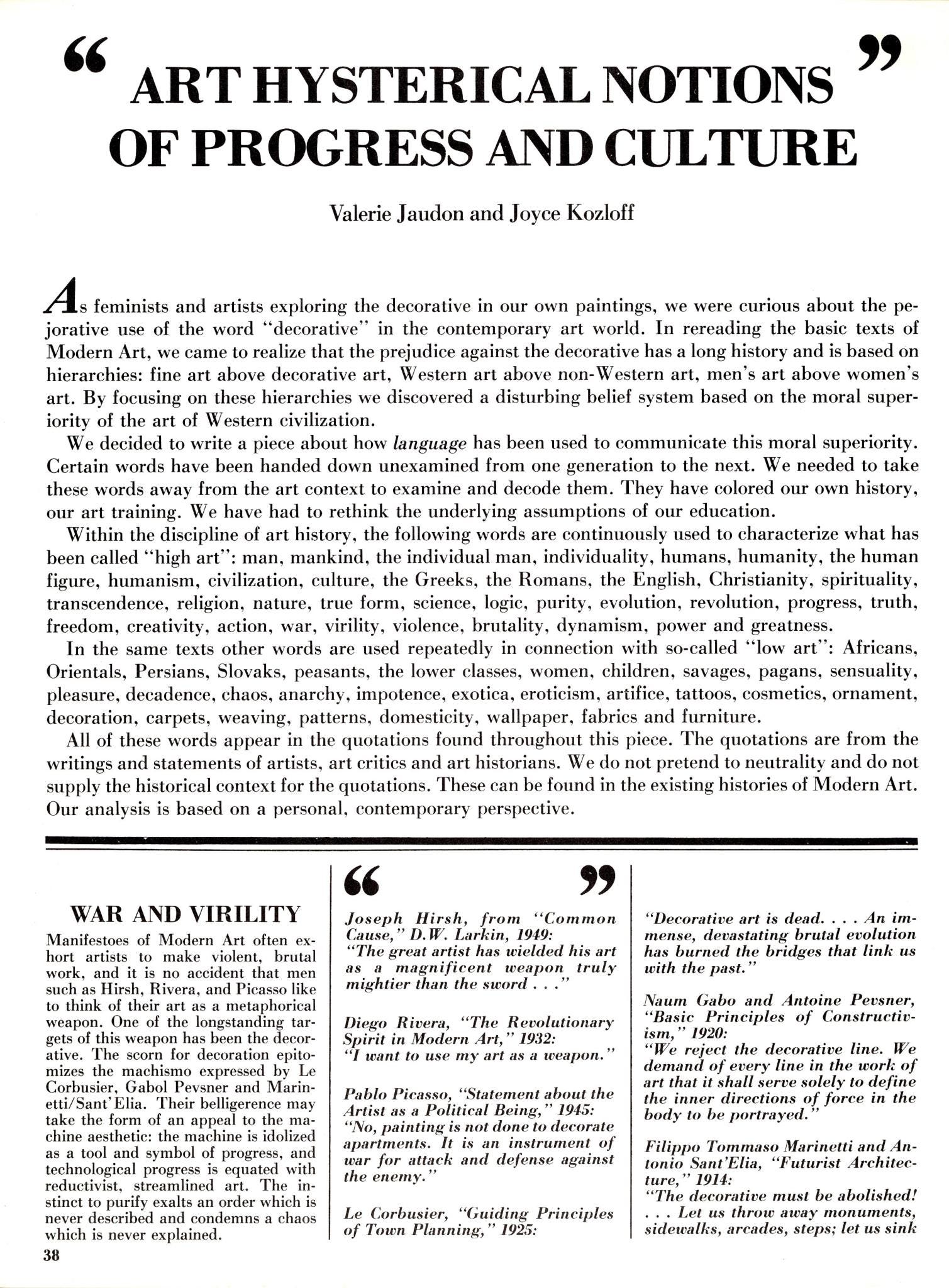
They quoted Kirsh, who said, “The great artist wielded his art as a magnificent weapon truly mightier than a sword;” Rivera, who said, “I want to use my art as a weapon;” and Picasso, who said, “No, painting is not done to decorate apartments; it is an instrument of war for attack and defence against the enemy.”
The three quotes were made between 1932 and 1949, during the height of Modernism. Supposedly, Modernism embraced newness, summed up by the title of Ezra Pound’s 1934 collection of essays, Make it New. But beneath the surface, Modernism continued the old belief in patriarchy, militarism and Western cultural supremacy. At the Bauhaus, the most famous and progressive Modernist art institution, female students were not allowed to study painting or sculpture. They worked with textiles, a medium associated with so-called “women’s work.”
Another point Jaudon and Kozloff made in Art Hysterical Notions of Progress and Culture is how the official canon of art history systematically discounted the work of artists who did not fit in with the majority. Female artists were discounted, as were gay artists, disabled artists and artists from non-Western cultures. Among other falsehoods, this allowed Modernists to claim they invented geometric abstraction, when Islamic artists had mastered it centuries before, and monochrome painting, which Hindu artists had been making for millennia.
Modernists saw themselves as representatives of “the culture”, which was, in their minds, Western, straight, male and attached to its own siloed history and sense of importance. Jaudon and Kozloff showed how language was used to shape that perception and manipulate outcomes. They hoped their essay would inspire readers to challenge the assumptions of their education.
Jaudon and Kozloff were hardly the only artists of their generation to challenge the limited version of art history being taught in schools. In his 1969 essay Art After Philosophy, artist Joseph Kosuth wrote: “Being an artist today means to question the very nature of art.”
Kosuth explained that if you say you are questioning the nature of painting, you are actually not questioning the nature of art, because to even accept painting as a form of art means you are also implicitly accepting the tradition to which painting belongs, aka Western canonical art history. The essay made him a leading protagonist of what became known as Conceptual Art. And his critique of traditional forms was so effective that for decades, every art student was saddled by the cliché that “painting is dead”.
Then in the 1990s, something happened that suggested that maybe painting has not lived — the Internet became widely available.
Global digital interconnectivity profoundly weakened belief in the inherent dominance, superiority or even existence of a monolithic Western culture. It made clear to everyone that there are (and always have been) innumerable cultures co-existing alongside whatever culture or cultures are momentarily dominant; not sub-cultures, but co-cultures.
There are eight billion people today, each belonging to numerous cultures. There could be 50 billion, 100 billion or a trillion co-cultures co-existing at any moment. Co-cultural respect demands we no longer pretend to believe in universal values. This is why there is no longer “an avant-garde”. Every contemporary artist is an avant-garde of one.
The Avant-Gardes
Many consider the end of a singular avant-garde a welcome development. Artists no longer need to feel pressured to contextualise their work in terms of bigger cultural constructs or a single narrative of progress. They can choose which art historical story they belong to. It can be the traditional Western canon if that is what they want; it can be Modernism. Or it can be something global, or hyper-local, specific to a particular culture to which they belong. Having agency over their artistic position means they can ignore the manifestoes and movements of the past if they want… or they can build from them. And they can decide for themselves if their mediums are dead or alive.
Chinese artist Shao Fan describes his personal journey as an artist as a negotiation between competing influences from Western art history and Chinese tradition. “For nearly a century, traditional culture had been continuously suppressed or devalued, Shao says, from the May Fourth Movement through the Cultural Revolution, and even after reform. Western art arrived with such force that it became another form of forgetting. We began to look at ourselves through Western eyes. Only in recent years have we started to return to our roots. Chinese art today still learns from the West, but the need to reconnect with our own traditions has become stronger. For me, that balance — between outward curiosity and inward return — has defined my entire path.”
James Little enthusiastically embraces Western Modernist values, not because that is the only history he values, but because it relates to his personal pursuit of virtuosity and creative freedom. He also embraces the title of painter. “I have taken a lot of criticism for the way I work, Little says. I have been called a formalist and “this and that”, and some of that is true. But, I think to be a formalist, and couple that with painting, you really do have to know what you are doing. And it is not a word that you just toss around lightly. I see it as a badge of honour. I am trying to make paintings that somehow reflect the extension of modernist concepts. Or abstract painting. Or even modern painting. That is where I am at. So if you are interested in painting, or abstraction, then you have to give my work a hard look.”
Bernar Venet, who most people would describe as an abstract sculptor, has never described himself according to a single medium or intellectual approach. He joins Kosuth in a belief that the medium is irrelevant, and that ideas are all that matters. “To me, it is obvious, Venet says. I do not understand how one can speak of painting, sculpture, literature, music as if they were separate worlds. To me, it is the same thing: imagination, invention, the question posed. I always return to the same principle of equivalence: that the argument can be expressed in any discipline, any medium. What matters is the proposition, the thought, not the support.”
Jessica Stockholder, meanwhile, describes being an artist as her way of knowing herself and others. “I have not always found it easy to be with myself, she says. Being in the studio is a way of being with myself while also talking to the world.”
Richard Tuttle echoes that sentiment, noting that for him being an artist is about creating unity from disparity. “You would never be an artist unless you were born to be this way, Tuttle says. Being born this way has a characteristic that you are absolutely ambiguous about everything. Nothing you experience, or can say, does not have an equal and opposite place or validity in your mind. Because of this, you are always trying to make a unity. One characteristic of art, whether it is Western, or recent or old, is that there is a unity that happens in a made thing.”
Critical Revival
If artists are frontline culture warriors, art critics have typically been seen as the rear guard — a grimy cohort following distantly behind the battle, noting what could have been done differently and to better effect. Happily, the rise of the “avant-garde of one” also has the potential to set art critics free. Critics no longer have to base their criticism solely on the linear canon of Western art history. They can judge each artist on the terms the artist sets forth for themself. If an artist claims they are doing something with their art, the critic can simply judge how well they are doing it, or if they are doing it at all. If an artist says they are working within a particular tradition, the critic only has to judge them according to that tradition’s rules.
This shift has been embraced by some contemporary critics. In a recent article in Hyperallergic about the work of artist Rashid Johnson, art journalist Seph Rodney mounted a substantial and well-supported critique of Johnson’s latest exhibition based solely on the fact that Johnson is not living up to his own declarations about his work. This critique respects Johnson as a solo culture, holding him accountable only for whether or not he is advancing his own guard.
Other critics, however, abhor this change, and even call it the death of art criticism. Maybe they are uncomfortable losing their critical entitlement. For so long, reading the right art history books and taking the right classes has made them the experts in the room. Now they must put in the time to learn specifics about particular artists, including perhaps studying different cultural histories, different concepts of beauty or different philosophical traditions before either trashing or lionising a particular artist’s work.
It is a heavy lift for a critic, just as it is a heavy lift for an artist to have to individuate rather than follow a trend. But in a world where there is no dominant culture, no universally agreed upon cultural values and no singular artistic avant-garde, it is also a more honest approach to art. It argues that the most important thing an artist can do is discover what they were, as Tuttle says, “born to be.” And maybe the most important thing art journalism can do is provide opportunities for artists to converse honestly about that process. This could mean the death of art criticism is the re-birth of the artist interview. Instead of offering answers, critics can, as Kosuth recommends, focus on asking “the right questions.”