Originally published in AMA Art Magazine, 2026
How many different words can you think of for rain? Artist Miya Ando recently published a dictionary through MIT Press called Water of the sky, that lists 2000 Japanese rain words. Keame means “fine rain that looks like a fiber”. Bunryūu means “rain that splits a dragon’s body in half”. Takuu is a “blessed rain that quenches all things in the universe”. Each of the book’s definitions is illustrated by one of Ando’s indigo paintings, which evoke the feeling of the type of rain being described. The book opens with a quote from Zen Buddhist priest and poet Ikkyu, who wrote that priests “should learn how to read the love letters sent by the wind and rain, the snow and moon”, before studying sutras.
“Ikkyu is saying nature can hold profound Buddhist truths, just as sutras and lectures, Ando explains. In my practice I am dealing with natural phenomena, where there is a vocabulary for philosophical things. When you look at clouds and they change in the sky and turn into different shapes, that is beautiful, but it has also been codified in Buddhism as a metaphor for all things being impermanent and constantly changing. Clouds are no different than you. As humans, our time is temporary on Earth. Clouds express the human condition.”
Ando was raised in a Buddhist temple by a Buddhist priest. However, she says she does not make Buddhist art. “Is there a direct line to my art from my religious upbringing? Maybe. My dad also has a PhD in electrophysics. Is it because I was near a physicist? Perception is not an abstract concept. It is something that can be experienced. Humans have fundamental questions, across art and cultures, about how we understand time and experience nature, and how we perceive these things. There is a material experience of nature evidenced in my work. So, are the works Buddhist? I do not like to say that they are. Maybe I am just a Buddhist proselytising! I hope I am not because Buddhists do not proselytise. I just believe in the equation that has been set up by Buddhism that states everything is ephemeral.”
Lewinale Havette would also not describe her art as religious. Havette was born in Monrovia, Liberia, where her father was a leader in the Methodist church. Her mother, an Indigenous Liberian, was raised with more nature-based religious beliefs. Religious tensions in Liberia, where Christianity has been used to subjugate Indigenous people, caused Havette’s family to emigrate, first to Côte d’Ivoire and eventually to the US, where her father pursued theological studies. As Havette has gotten farther from the experiences of her youth she has begun stripping away and rebuilding her relationship with religion and spirituality.
I” am not religious, Havette says, but I did have a religious upbringing, and spirituality is always at the core of my practice. Spirituality is less about religion and more about ways of being, ways of doing things; understanding and appreciating nature; being able to see and hear things without talking to a quote unquote god; understanding what is on Earth and in the heavens, things unseen. That is more connected to what I am trying to get back in touch with.”
Havette’s latest exhibition, ““Playing with fire” at Von Racknitz + Baer Gallery in Berlin in partnership with Palo Gallery New York, features 16 new paintings that depict female bodies in poses suggesting power, sensuality and suffering. She describes this body of work as the first time she led with intuition and a sense of the spiritual. “It carried a sense that I was a vessel”, she says. The brushstrokes are frenetic and minimal; the colour worlds verge on monochromatic. Several titles reference metaphysical ideas.
The mercy of not pretending, the largest work in the show (274.32 × 132.08 cm), depicts stacked bodies, twisted, maybe in ecstasy, maybe in pain. It is rendered in black paint and ink. “I see in this painting how romantic love ties into an understanding of our higher self, Havette says, especially the good love, the one that challenges you. That love ties into a breaking open of your higher self. In many West African cosmologies, experiences are understood through the energies they carry and how we move with them. Romantic and embodied forms of connection can open us, unsettle us, and bring us into a deeper awareness of the self. These thresholds are not good or bad in essence. The harm begins when we impose a judgmental framework on our inner life, especially the inherited Western religious habit of dividing impulses into permitted and forbidden. I am not suggesting that every desire should be acted upon. I mean that the internal act of labeling our experiences as morally right or morally wrong can distance us from what those energies are trying to reveal.”
Between two worlds
Havette’s painting Seventh son is a yellow monochrome painting that depicts multiple superimposed perspectives of a female head. Its title references a common male figure in West African spirituality and folklore. “The seventh child tends to be this threshold being, Havette says. It sits between worlds and carries insight. The son, the male child, tends to be the celebrated figure. I am flipping that in this painting, because my work focuses on women. This mystic being has insight into more than the physical. She is the ancestral mirror between worlds.”
Ando also walks comfortably between worlds. There is the Buddhist world of ideas that compels her to make art; then the world of the contemporary art market, where she is represented by commercial galleries, accepts public commissions and takes on collaborations with brands. Her most recent brand collab was with the Beverly Hills outpost of luxury fashion house Saint Laurent. It might seem hard to imagine a more opposite representation of Zen Buddhism than a luxury store on Rodeo Drive. But Ando saw it differently.
“Creative director Anthony Vaccarello liked my work and had seen it in a number of places, Ando says. I went to look at their space in LA because I was already going there, and I liked the way they thought about art. I see their thinking about fashion and lifestyle and why there is a connection to my work. The genesis of Saint Laurent’s style, as well as my style, is informed partly by Zen reductivism, in my opinion.”
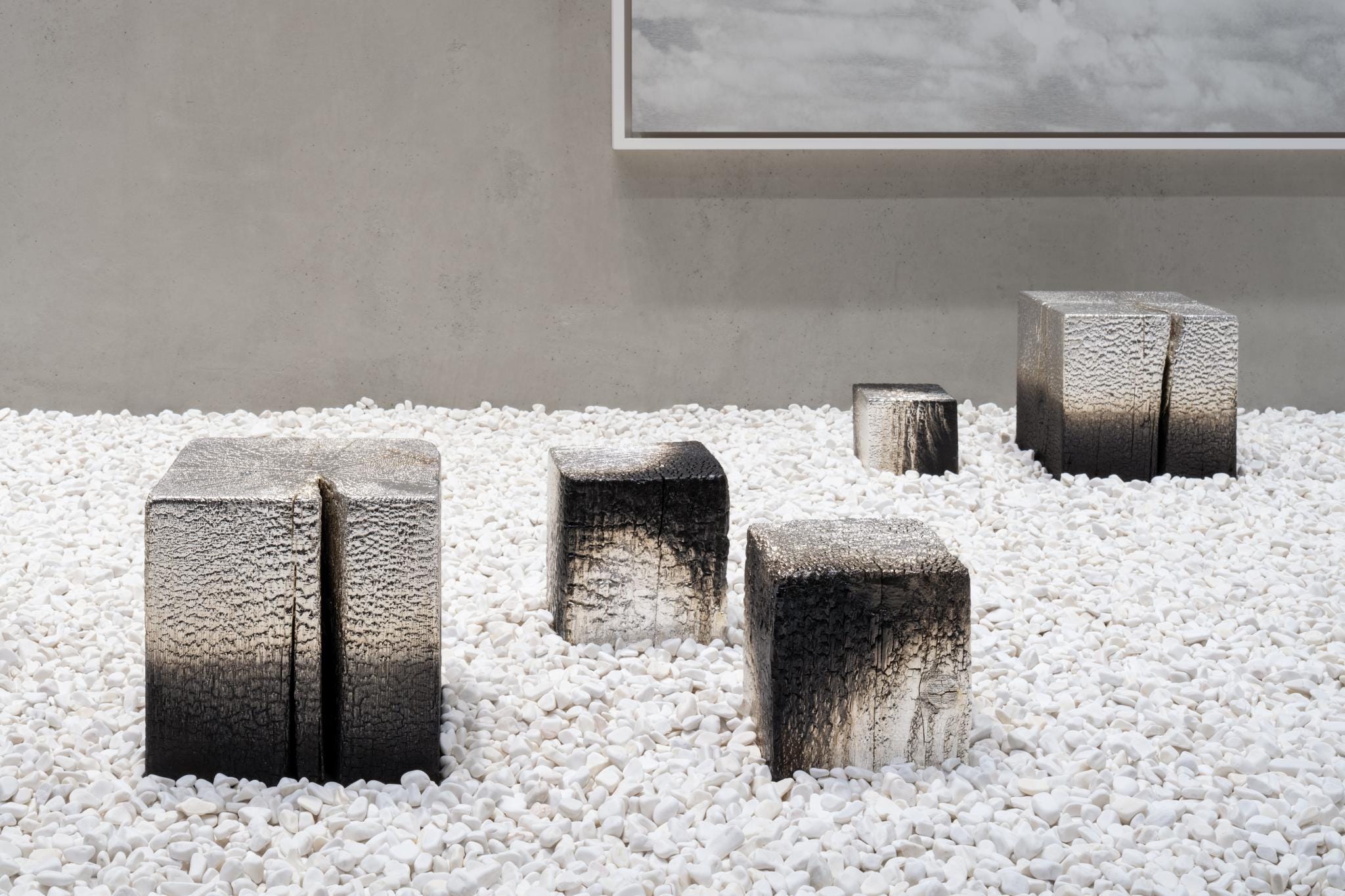
Ando recreated Ryōan-ji, the most famous Zen garden in Japan, inside the Saint Laurent store. “It is just 15 stones on gravel, Ando explains. It is the embodiment of Zen reductive thought, and by that I mean without anything extra. The 15 stones are of varying sizes and shapes. The viewing place is this long veranda, but from no one place can you see all 15 stones. One is always hidden, regardless where you are. I recreated that on a smaller scale at Saint Laurent with charred cubes of wood. You could see them all at once. That changed the inherent quality of the original. It was a way of shifting the perspective. That is one of the foundational concepts of wabi-sabi, a Japanese concept that arises from Buddhism. Part of what it means is that nothing is perfect and all things are impermanent. So this garden is representative of those ideas.”
On the large wall behind her recreation of Ryōan-ji, Ando placed one of her cloud paintings. For this body of work, Ando photographs clouds, recording the exact date, place and time of the observation, creating a record of a fleeting moment. She later paints amalgams of those clouds in ink on metal. “Clouds are impermanent and the metal suggests permanence, Ando says. That is the language for this inquiry. The work is archival, it is not ephemeral. But the overarching idea is that everything is impermanent.”
Inquiring not prescribing
Religious organisations have a long tradition of commissioning artists to make artworks that prescribe their version of truth. And there are artists making overtly religious artworks on their own that attempt to expand those official religious narratives — as an example, Crowning by Esther Strauss, which shows the Virgin Mary in the act of giving birth to Jesus. Then of course there are artists who make art that mocks religious art — like Andres Serrano’s famous Piss Christ or Maurizio Cattelan’s La nona ora (The ninth hour), which shows the Pope being smashed by a meteorite.
Less attention comes to the artists who are not prescribing spiritual truth with their art, but rather inquiring about it. This type of work has just as much power to affect the minds of the people who encounter it. “I am posing questions to myself, Havette says. It is a personal search. But when you are asking spiritual questions in the works, you have an audience that starts to also ask those questions. It is this net, this bag over all of our heads to various degrees; a blanket of spirituality that covers the work.”
Havette says she has an increasing awareness that the people who collect her work are looking for transcendence. “I am hearing the feedback. Collectors come by and tell me, ‘Every morning I wake up and this is what the work does to me, and this is how it does it.’ And often the things they are seeing are similar to the things I am looking for when I am creating the work.” When this happens, Havette says she laughs to think that in some way she might unintentionally be following in the footsteps of her minister father, just without the weight of organised religion. But that is never her intention. “People make gods of objects, she says. They make icons. They make gods of people, too. It is not the artist. The viewers make it this elevated thing. But it is less about hardcore religion for me. I am trying to understand so much more — romantic relationships, sexuality, power dynamics between men and women. Those things are key to me understanding my higher self and what it means to be in touch with that.”
Ando is also not in the business of making icons or prescribing truth. She makes art in service to something that is ultimately personal — the search for a system of thoughts that makes sense. “I have a belief and a reverence for something beyond myself, Ando says. I grew up with that conditioning. It is like having a veil over your eyes. All that stuff formulates how you are going to perceive the rest of the world for the rest of your life. For me that meant there is a deity in the mountain, in the waterfall. Nature is not just nature. There are 72 seasons. There is a season for when the geese come home. There is a season for when the frogs start crying.”
But Ando also realises there is this idea that specific beliefs matter, and do not matter. “I think what we are trying to do with our belief systems is make things peaceful, she says. Whatever paradigm works. Call it a religion or not. I make art so I can reason and reconcile questions that I have. The title of my exhibition in Beverly Hills was “Mono no aware”. That is a Japanese term that means an appreciation for ephemerality. It is not nihilistic or negative. You are lucky to see that rain. You are lucky to recognise a shooting star or a sunset or snow that fell right in front of you. It was beautiful because it was short-lived. That is something that is informed by Buddhist thought, but then again these are just profound truths. It is secular and non-secular. You can choose.”