Originally published in AMA Art Magazine
In 2024, Jessica Stockholder and her husband, artist Patrick Chamberlain, left their long-time home in the United States for their native Canada. About their new home, which overlooks Departure Bay on Vancouver Island, Stockholder jokes: “We bought a three-car garage that came with this odd house. The garage is a good studio.” A quintessential multi-hyphenate (painter-sculptor-installation artist-public artist-writer-teacher), Stockholder recently retired from a long and legendary career as an art professor, first at Yale, then at University of Chicago. This is the first time in years she has had the luxury of making objects in a studio full-time.
Yet, Stockholder’s exhibitions are never just collections of objects on display. They are better described as multitudinously layered aesthetic phenomena. The gallery space, with all of its pre-existing components, as well as any and every material substance within her grasp is potential material for Stockholder’s visual compositions. The first question she answered for this interview was about the meaning lurking within those layers.
“It is an accumulation of things, Stockholder says. The art that I value, that I think is strongest, is not linear. It makes room for emotional life of all kinds — beauty, stress and discord. It makes all things tolerable in some ways, like a way of managing trouble in life. Life is never easy. Painful stuff happens — people get sick, live with horrible things. You have to accommodate unhappiness. You cannot be alive otherwise. That is part of what art is useful for.”
What you are working on right now in your new studio?
I moved here just over a year ago, and it took me probably about six months to settle enough to get my studio going and get myself going inside the studio. Now, I am working on some smaller works. They are for a two person show that I will have at Catriona Jeffries Gallery in Vancouver, with the painter Eli Bornowsky. I am sort of hesitant to talk about what they are and how they will come together, because they are so in process. But in general, I am trying to work out how to make things that are smaller and have presence and perhaps address space even though they are small materially. And I am thinking about lines. Metaphorically, you can talk about lines and how fat it has to be before it is not a line anymore, etc. I also keep thinking about writing poems. I have been wanting to do something that is between language and image somehow. I am reading a book, The Master and his emissary, by Iain McGilchrist, that a friend here recommended. His description of the mind and how it works, and the kinds of questions he is asking, puts words to things I have been thinking about for a long time, in terms of what it is like to be in the studio and the relationship between language and apprehending the process of thinking in the studio, which is not, for me, a very verbal process. I am enjoying that not teaching is letting me be involved in the work really differently. I also had a show that just came down at MOCA Toronto and I did a big show in Spain, in Palma, at the Es Baluard Museum.
What was the show in Toronto like?
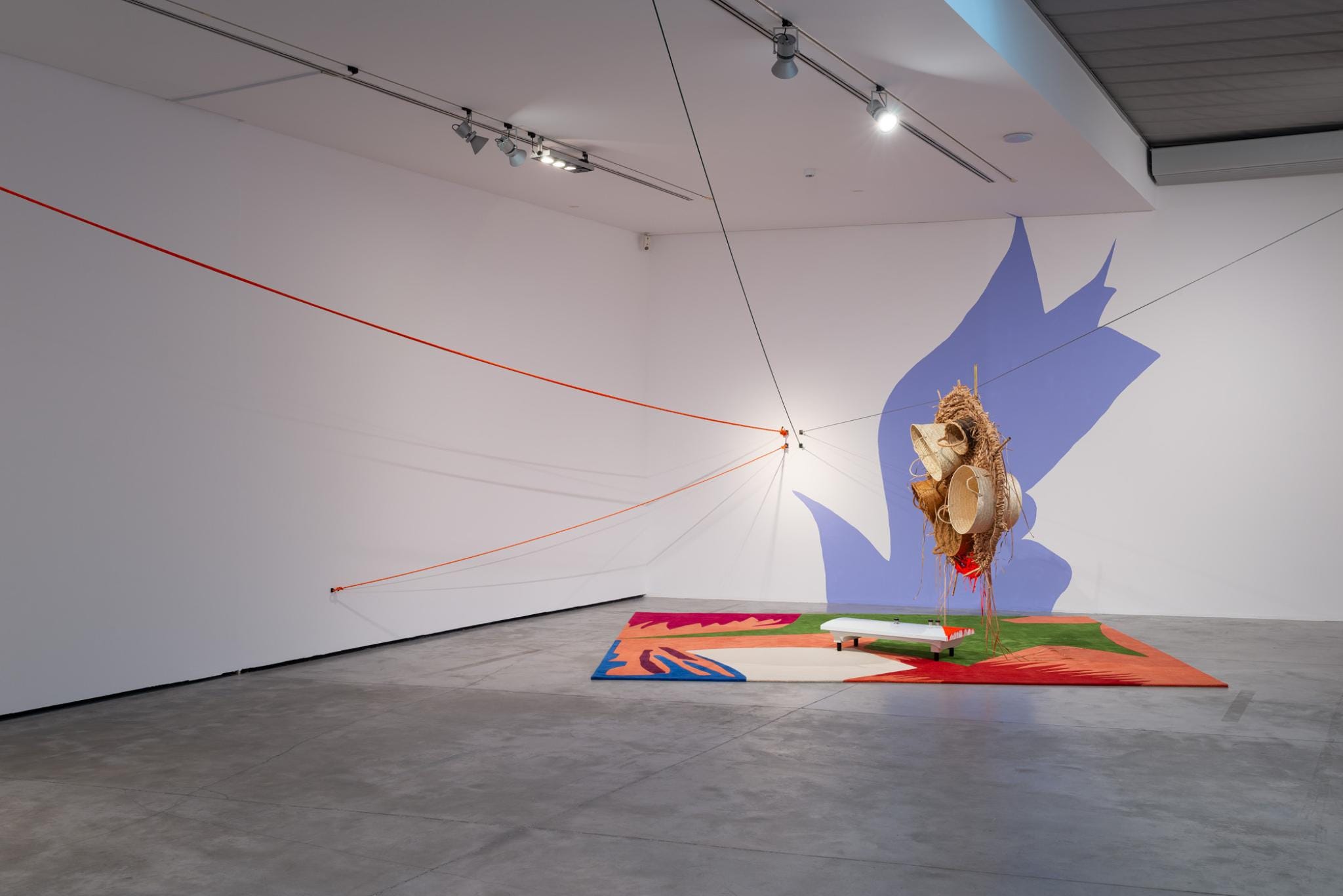
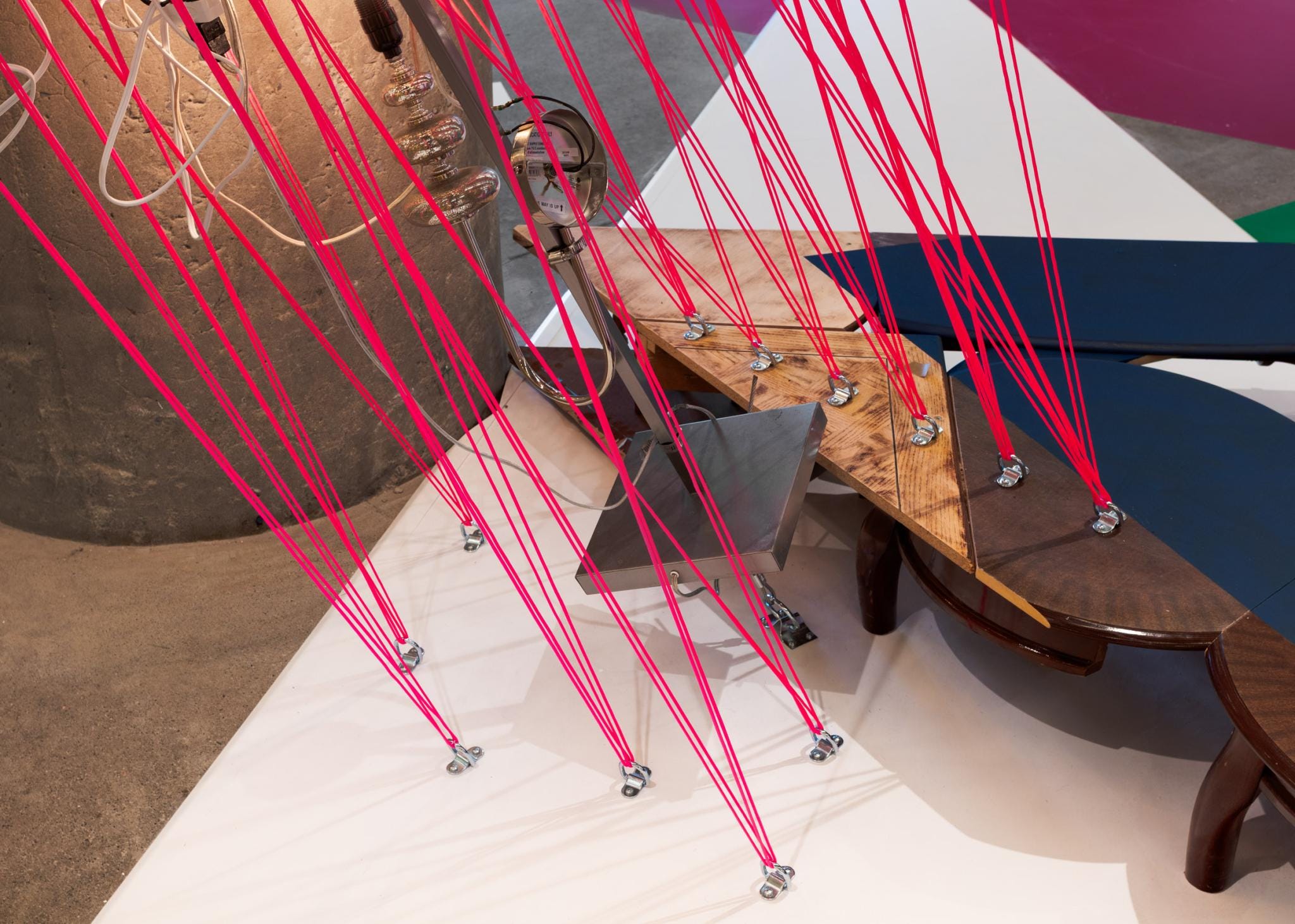
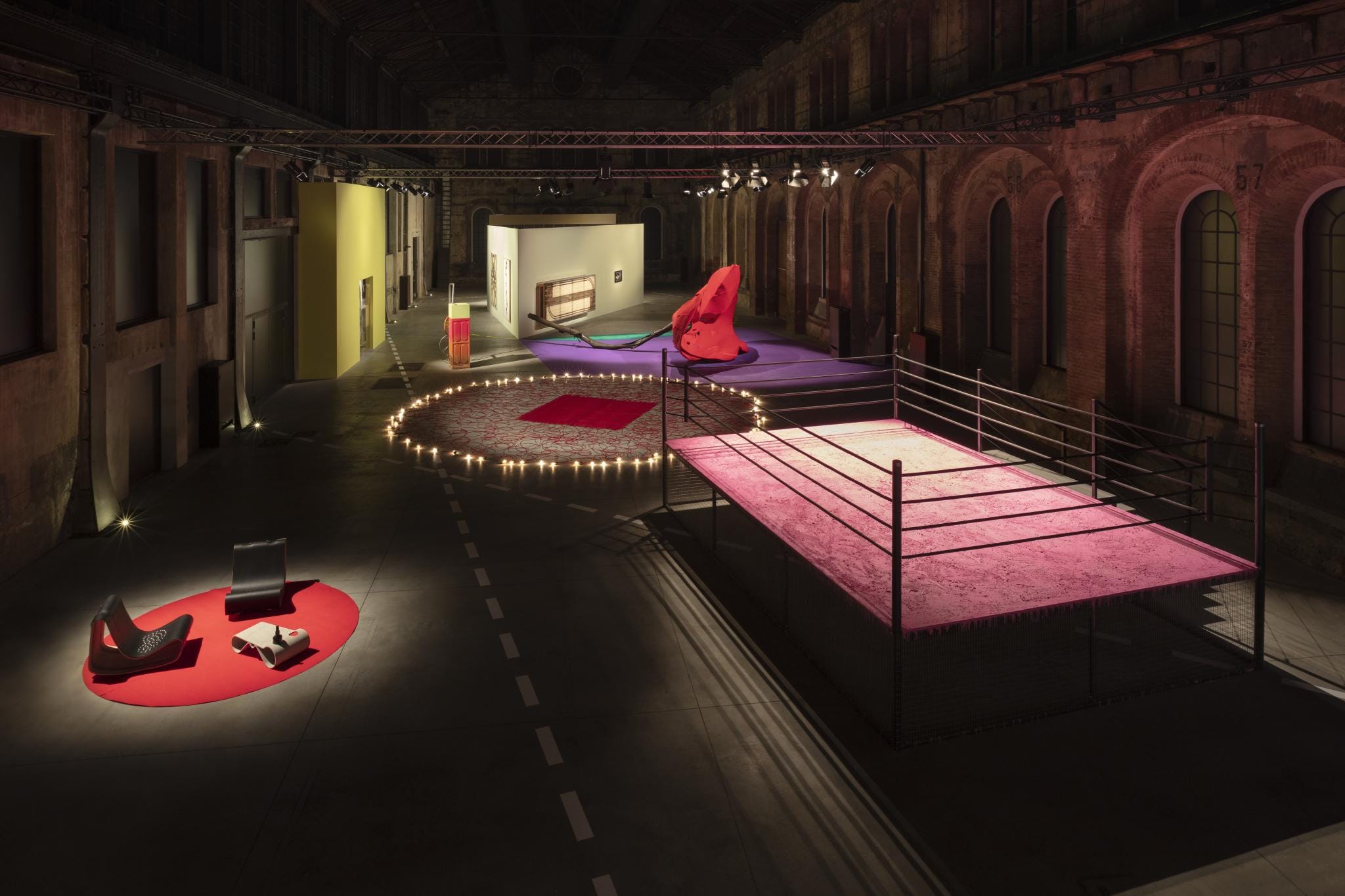
It was called “The squared circle: Ringing”. MOCA has four floors and most often there is an artist on each floor. They do not always show site-related work but they enjoy and tend to support that kind of practice. I was on the ground floor, which is a really awkward space for many to deal with. There is an entryway on two sides, a desk that greets people and a cafe with a glass window open to the exhibition space. It is not a clean, white-cubish kind of exhibition space. It is a little complicated in terms of traffic flow and what people expect coming in. But I really enjoyed it. “The squared circle: Ringing” followed a show that I had made in Torino during the pandemic titled “Cut a rug a round square”. In that show, I was curating work from a couple of other collections and it was supposed to be a painting show. It was not just a painting show but was tethered there. There was a wrestling ring stage thing that you could stand on and view the rest of the show. There was a dashed line in the middle of the floor, organising passage through. All of the works in that show focused in different ways on the circle and the square. This show in Toronto following on that show was not a curated show, it too has a kind of wrestling ring structure, and it had triangular wall structures related to the show in Italy. In addition I placed a bunch of poem “things” on the walls. The poems kind of rattled together with all the mess on the walls that everyone likes to ignore, like fire notices and exit signs. There were also a couple of videos, one which I had taken in Chicago of some hydrangea blooms in the wind, looking really anthropomorphic, moving around and kind of fighting. The other was of a hedge here in Nanaimo also being blown about by the wind.
One of the video screens was hung next to an air vent that was the same size as the TV…
Yes, and the vent, in addition to blowing air, has a sound coming out of it matching the sound of the wind of the blowing hydrangeas. The two sounds were beautiful together. I came prepared with that video knowing that I wanted it to be part of the show, but I did not know just where it would be exactly. And of course, I had not taken account of that vent. Things like that happen. Being there, you see things, feel them and can respond to them. That is part of a thinking process, of making something; and yeah, I really love that moment in the show.
How have your ideas always been so layered and complex?
I started as a painter. I was wanting to learn how to draw and my dad arranged drawing lessons from Mowry Baden, who is quite well known out here as well as a great teacher. I went to UVic to study with him for my second two years of college. I also studied with another painter in Vancouver, Nora Blank, who was also influential and helpful. Baden is a sculptor very interested in the body’s relation to experience. Working on a piece of paper or on a canvas, illusionistic space emerges immediately. Put one mark on the thing and it becomes an illusionistic space unless you resist it mightily. I love that but I also felt too powerful inside of that space. I wanted to encounter more resistance from the world. So I became interested in the materiality of the canvas and I started to be interested in the space between things and the wall. Then I put lots of stuff in the paint, you know — toilet paper and marble dust and stuff mixed up in the paint to give it physicality. And then minimalism — which I really love, though my work does not tend to appear too minimal — really called attention to the question of the pedestal, and the space of the body in the room with art. I went down that road and was compelled by how context figured into everything. My parents were both English professors very involved with the life of the mind. That was a kind of gift. Though I also found a discord between the abstraction of intellectual life and a relationship to the immediacy of experience that is a huge part of being alive. I am compelled by the relationship between abstraction and the sensuality of immediate experience. My work is at once very concrete and immediate, and also abstract. It calls attention to how those things bump into each other.
Was that something you understood at the start of your career?
I certainly would not have been able to say any of that. I am able to speak to these things looking backwards, putting words to what was motivating me, how I was feeling, why my interests went the way they did and why I cared to do the things I did. And still today I am not able to put words to what I do in advance of making. It is a process of thinking, being in the studio.
What meaning do materials have in that process?
I do not have a single answer to that question. Many answers kind of all at once. I think about the sensual part of art, which maybe is what we mean by aesthetics being attracted to something, viscerally, without concern for what it means, like a crow likes shiny things. Something about colour is sensually engaging and then becomes meaningful. So at some level, a more backed-off level, I could make art out of anything. Give me anything and I can find a way to do something with it that intersects the things I care about, which have to do with an intersection of my engagement and making with something that I did not invent, that was there before me. So everything in the world, outside of myself, qualifies on that level. But then, through the process of making things over my lifetime, that process of making and engaging the material world made me much more curious about how things, or stuff, is meaningful. It is not like I thought: “Oh! I have to tell a story A, B, C and D.” That is not how I came to the work. Rather, engaging the work and the world through my work, awoke curiosity about how these things are meaningful. Things can be meaningful in so many ways. A material can be just the right material because it has the exact right colour. And at the same time, who made it, how it was made, what it is made out of, the history of that object is there in the work, kind of hanging out sideways attached to the colour, which is its primary reason for being there. In other ways, there are times where all those meanings that are attached to the object become players in the structure and organisation of the work. I have noticed over the years I have used a lot of refrigerators and refrigerator doors; there is something really lovely about the intersection between the white cube gallery space and the white cubic refrigerator, that both of them hold food of different kinds, full of care and love. So things become meaningful in many ways. Then in a more general way, I am invested in the personal piece of art making. I make the thing. It has something to do with me, the gesture of an individual human in contrast to many of the factory made things I use. Sometimes stuff is machine-made, extruded by machines, sometimes it is actually people’s hands making stuff in a factory, but we do not know whose hands and their name is not attached to it. All of these things were designed by someone, but again, most often their name is not attached to it. So I am in dialogue with lots of other people in an entirely different framework from the one that the art world has put me into. Then the replicability of all those materials is relatively new, that we have thousands of objects that are all the same. That replicability is kind of analogous to abstract thought that can be passed around in a video, text, or in language. Abstract thinking is replicable in the same way as the goods produced by our economic systems. But the work that I make tends not to be reproduced; it tends to be proposed as a one-of-a-kind. It could be reproduced. It would be a lot of work for somebody to reproduce it and make it look just like I made it look, but it could happen; it has not happened. All of these systems of making inflect the meaning of materials. And then there is time: how time inflects the meaning of things. Objects have history. Sometimes they accumulate evidence of use and sometimes they were made in the 1950s, not today, or whatever, so time gets pulled along with them. But I am rarely engaged in the kind of storytelling like with the refrigerator and the white cube. I came to that story looking backwards and noticing how often I have used those things.
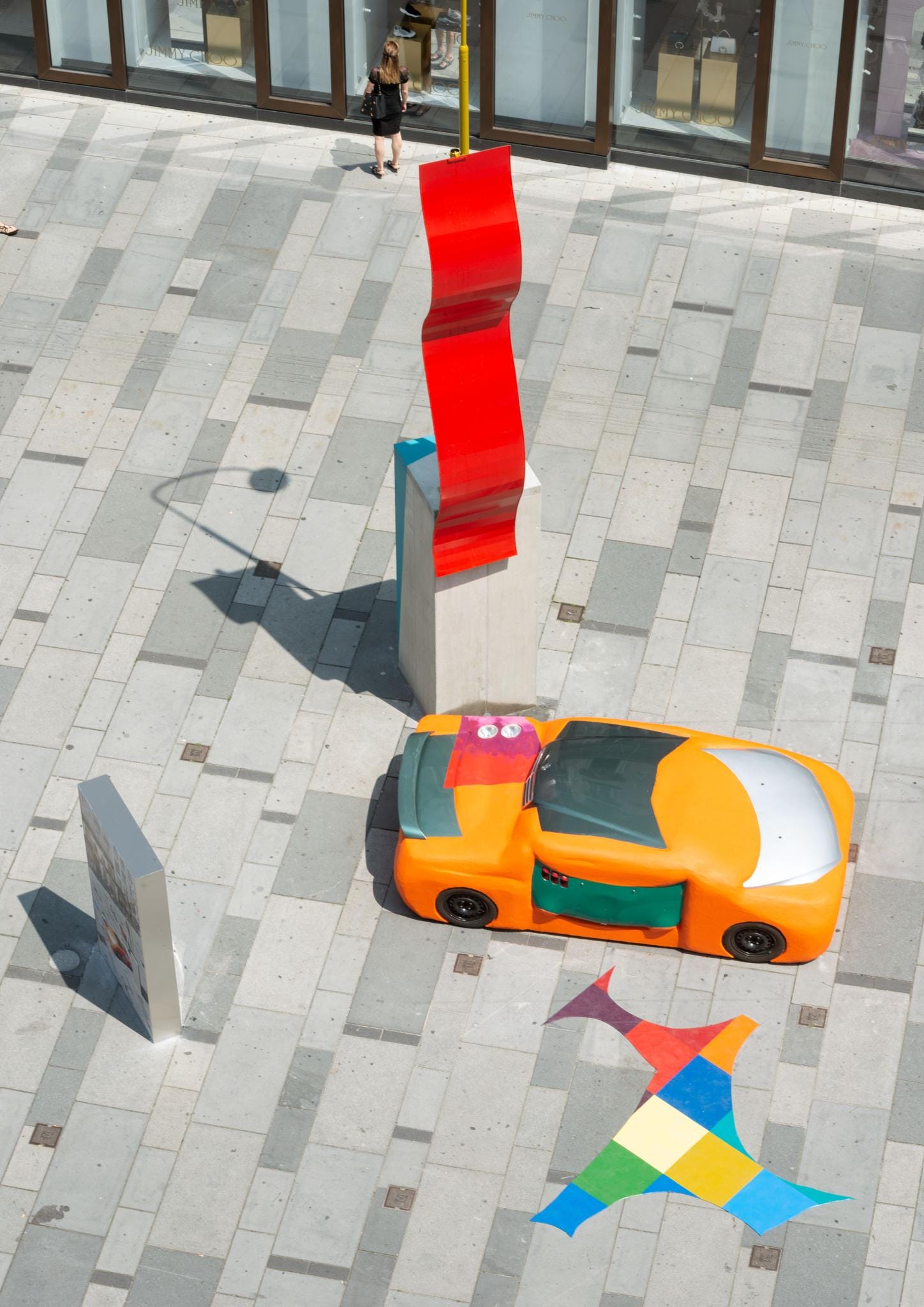
What does it mean to you personally to be a professional artist?
I have been extremely fortunate to be able to be an artist and have it be my profession. It is not like deciding to be a lawyer or a dentist or something, where there are jobs out there for you. My mother said to me in high school: “Jesse, do you think maybe you should also study something that, you know, you could make some money at?” And I said: “oh, Mom, do not be ridiculous.” I think it was a way of being with myself. I do not know if everybody has trouble being with themselves. We are social people, animals, and very few of us are hermits. Most people need these social networks and interconnections in the world. I imagine that being a theatre person is a very different way of being than a writer or a visual artist, where you put yourself alone a lot. I have not always found it easy to be with myself, but I really wanted to be with myself anyway. Being in the studio is a way of being with myself while also talking to the world. So yeah, it serves me in that way. It has given me a particular kind of community. I mean, identity politics is such a big deal these days. We all have the colour of our skin, the social group we are born into, the history of our peoples; and art, in the Western world, has enabled another form of connection to identity. Being an artist has brought me into contact with many different kinds of people; and the work speaks to a world past the immediacy of oneself. I have found that valuable. It seems that a lot of interesting art has emerged from times where people are stressed in relation to their identities, their social groups and politics. A lot of great work came out of East Germany, before the wall came down and as that struggle happened. My parents were New York secular Jews who found jobs in Vancouver, so we did not have deep roots there. Making art was, for me, a way of finding a place in the world, a way of growing some roots. So I was just really fortunate. If I had not been an artist, if I had been better at math and stuff like that, I might have liked to be a biologist. There is something about the workings of organisms and their structures and systems that I have always found incredibly engaging.
Is your work partly about the notion of finding value everywhere?
And to notice what is there, because we are asked not to notice a lot of things. And in fact, all those things we do not notice are the world we are living in. Like, when you go to a shopping mall, there is a kind of plastic surface to the world. All this stuff is not made to last forever. It is, in fact, planned not to. So we are in this world of our making, that we have to participate in, and the nature of the world is kind of like a false front. All these surfaces will not be there in 50 years. It is all very provisional, temporary, but we are not supposed to look past the surface of it. It is kind of like watching TV. I find there is something kind of sad and painful in that. My work is also presenting a surface in relationship to all the materials I work with. I use the surface of the materials, and I use their structure, and they all add up to something that is not them. I have access to all that Stuff at the shopping mall. It is all on its way to the dump — the clothes, the furniture. You have to be really wealthy to buy stuff that is not on its way to the dump. And even then, some huge percentage of it is. So I think my work exists in that world and I make an experience that is sometimes fleeting. Nothing we make lasts forever. So the relationship between immediacy and ongoingness, I just have a lot of thoughts, feelings and questions that float in there.
What is your relationship to the art market?
Well, over the years I have been fortunate to sell some work to private collectors and to museums. I also ask for an honorarium in relation to making ephemeral installations; sometimes more, sometimes less, depending. I have been fortunate to work with gallerists who have been committed to my work over the years. There are many different streams of valuing in the art world; buying and selling is just one of many kinds of exchange. There are different markets in different places. It is kind of a mystery how prices are arrived at; and people buy art for many different reasons. Some people just love art! Some people find themselves with extra money and enjoy being involved in the complexity of the art world. It is a place that brings many kinds of people together; it is a lot of things, not always pretty, but it is cosmopolitan… and the art marketplace provides a unique community.