Originally published in AMA Art Magazine, 2026
In an interview she gave long before reaching that milestone, Icelandic artist Björk spoke about how she cherished the aging process, saying it increased the abilities of artists, especially in terms of craftsmanship. “Some of the heroes in Iceland are authors, people who write books, and they write their masterpiece when they are like 60, she said. So it is like everything before 60 is a rehearsal. I think that is one of the beauties of getting older, is you become more like the ceiling of a cathedral. There are like a thousand pieces and it takes two years to make. So you are trying to get the whole.”
Björk also spoke about the underlying motivation she had to keep making music. “The nature of most musicians is generosity, she said. When you are three or four you want to sing a song that will make all the upset people in the kitchen happy. That is your drive. Even though you become a grown up, that is still what lies behind it all.”
Both of these quotes point to a desire to share with the rest of us what she, as an artist, feels on the inside. As anyone who has ever tried can attest, such sharing is not easy. It can be gruelling and painful. Every artwork exists only because some artist endured that, giving of themself make it exist. Chances are the artist only intended for it to be experienced by someone else; to be felt. But of course once it is out there, it can be monetised, fetishised, lionised or critiqued.
Björk has seen all four of those things happen to her various artistic gifts. Among her most critiqued offerings was a museum exhibition mounted at the Museum of Modern Art in New York in 2015. Unfolding across three floors of the museum, it featured a range of different works in various mediums, including music videos, sculptures, costumes and ephemera from her process. For super fans, the exhibition was a hit — they got a peek behind the curtain at the process of how Björk transforms her genius into aesthetic phenomena. Art critics, however, trashed the exhibition. They compared it to a tourist attraction, somewhere between a guided tour of Graceland and an afternoon with family at Madame Tussauds.
What was lost in those criticisms was the generosity, the gift. Björk made a new work for the exhibition — an epic music video for her song Black lake — commissioned by MoMA and filmed on location in Iceland by Chinese-American filmmaker Andrew Thomas Huang. The video was the thing that was intended to make all the upset people in the kitchen happy. The rest of the stuff in the exhibition was just background; relics of past gifts; fragments of happy memories of generosities past. As usual, the critics were pointing their gaze in the wrong direction.
Museum, take two
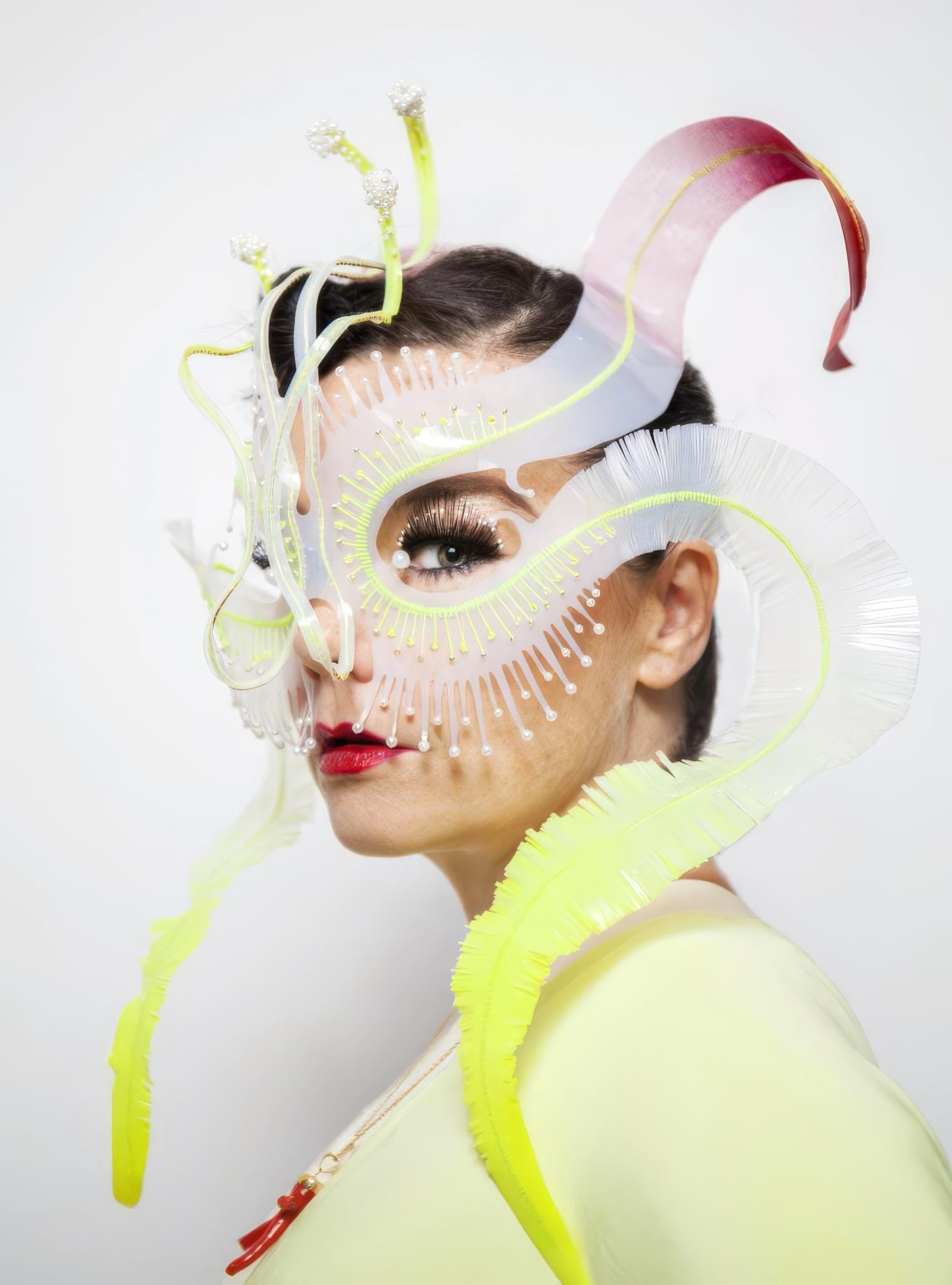
In summer 2026, Björk will take her second chance on a museum exhibition. This time it will be on her home turf, at the National Gallery of Iceland in Reykjavik. Björk will take over three of the museum’s four floors with installations featuring her works, and the fourth floor will feature the work of James Merry, one of Björk’s longtime collaborators. Merry is a costume designer of sorts, but it is more complicated than that. He is most well-known for making masks, many of which have been worn by Björk in her videos and performances. The title of Merry’s exhibition, “Metamorphlings”, points to the deeper experience for which Merry is striving. His creations have the power to help people change; to set themselves free to become something unknown, even to themselves.
“This whole exhibition started really with this idea of masks and how interesting masks are as a conduit for transformation,” says Pari Stave, head curator for exhibitions at the National Gallery of Iceland. “We were interested in the different types of masks that Björk uses, depending on the performance or the album, and how these conjure particular identities. That led us to James. His practice is in many ways focused on transformation.” Initially, Stave and her team were only going to focus the exhibition on Merry’s masks. But during conversations they had with Merry and Björk, it became clear there was a bigger opportunity. “In ‘James Merry: Metamorphlings’, we will show about 80 works, Stave says. It is a sort of retrospective of the last 10 years. It starts with the collaborations that he did with Björk, then it goes on to other works that he has done for other people, like Tilda Swinton and Iris van Herpen, and for himself as well. It spans a lot of the different techniques of making that he has used over time: first embroidery and then metalwork — he is a silversmith slash goldsmith — then it goes into silicone. Then for some of the works, about eight or 10 of them, you will also be able to watch short videos about what inspired the particular mask. That part goes deep into things like Celtic archaeology — his mother is an archaeologist — and other inspirations, like forms in nature and the whole notion of queer identity. He identifies as queer.” There will also be an interactive element, Stave explains, moments when viewers will be able to virtually wear the mask they are looking at, giving them a taste of the power to transform.
Echolalia
The other three floors of the museum, occupied by Björk installations, will be collectively titled “Echolalia”. The installations are conceived as immersive audio video experiences. The first two, Ancestress and Sorrowful soil, are elegiac works. “I would never presume to speak for Bjork, says Stave, but in both of these works she was feeling grief for the loss of her mother. I think she was also seeing the cyclical nature of life, you know, the pattern of life.”
Ancestress depicts a procession of musicians and dancers, evoking a funeral. Filmed in a remote, verdant valley in Iceland, it conveys a feeling of separation from civilisation, but connectivity to nature; there is something lamenting about it, but it also feels like a celebration. Merry designed the masks and the spirit elements for the performers. “When you enter the gallery, you will see Merry’s masks presented on the wall — the same masks you will see in the video, Stave explains. Then you go behind the wall and there will be this projection of the video at a really large scale, 10 metres wide. It is immersive and will have this great sound system. It is a rare opportunity to experience the emotional depth, visual richness and aural richness of the work.”
Sorrowful soil is an oval-shaped video accompanied by a choral work that will be broadcast through 30 speakers surrounding the room. The choral work was composed by Björk and sung by an Icelandic choir. “Each speaker is devoted to a singular part of the choir, Stave explains. When you are walking around the room, you can hear the whole piece, but the closer you get to a particular speaker, the more you are hearing just that voice. So you are going in and out from hearing specific voices to hearing the choir, that duality of the singular and the collective voices.”
The phrase “Sorrowful soil” may bring to mind a spiritual idea of dust to dust, or being buried in the dirt. But soil is also generative, like a garden where promise comes with the changing seasons. “Many people come to Iceland and wonder what it is that is so inspiring, says Stave. A lot of it is that there is the sense of human time, but there is also the sense that you are witnessing geological time. In the video of Sorrowful soil, you see the island is still very much forming. It is one of the youngest places, geologically, on the planet. It is only 25 million years old or so, much younger than, say, Hawaii. Björk is performing in front of the most recent volcanic eruption, at the site of Fagradalsfjall on the Reykjanes Peninsula. In 2021, when this was filmed, it was first erupting and you could actually hike there. Almost half a million people did. I went four times. The video was filmed in front of this formation of new land, this magma. So yes, dust to dust precisely.”
Björk’s third installation is still in process, but it will be centred on her forthcoming album, which is scheduled to be released in 2026. The museum can say little about it other than it will offer “an introduction to the latest chapter of the artist’s ongoing explorations of transformation and collaboration.” In the case of Björk, that is maybe plenty to know. As she says, transformation and collaboration are what artists are always after, hoping to make the unhappy people around them happy.
The exhibition will open on 30 May 2026, the first day of the Reykjavik Arts Festival, a biennial,16-day arts festival that highlights Icelandic artists, musicians, authors and performers. In that context, it is exciting to note that Björk turned 60 on 21 November 2025 — the age she said some Icelandic artists achieve their masterpiece. Was this timing planned?
“I would love to tell you that we had this grand plan for doing it right now from the beginning, says Stave with a smile. But it was just one of those things. I mean, there is never a bad time to show Björk. She is one of the great creative geniuses of this country. But as I explained, we really came at this not aiming so much to do an exhibition about her, but to do this exhibition about James and his masks. That just took off and led to other things. I can say in a general sense that what a curator does is based on studying art history, but as much as we can we try to understand what is going on in the culture. We see patterns and try to identify topics of interest that are relevant to the cultural moment. I think in this particular case, everything converged in a felicitous way. This is a really interesting moment to look at identity and transformation.”