(Originally published in AMA Art Magazine)
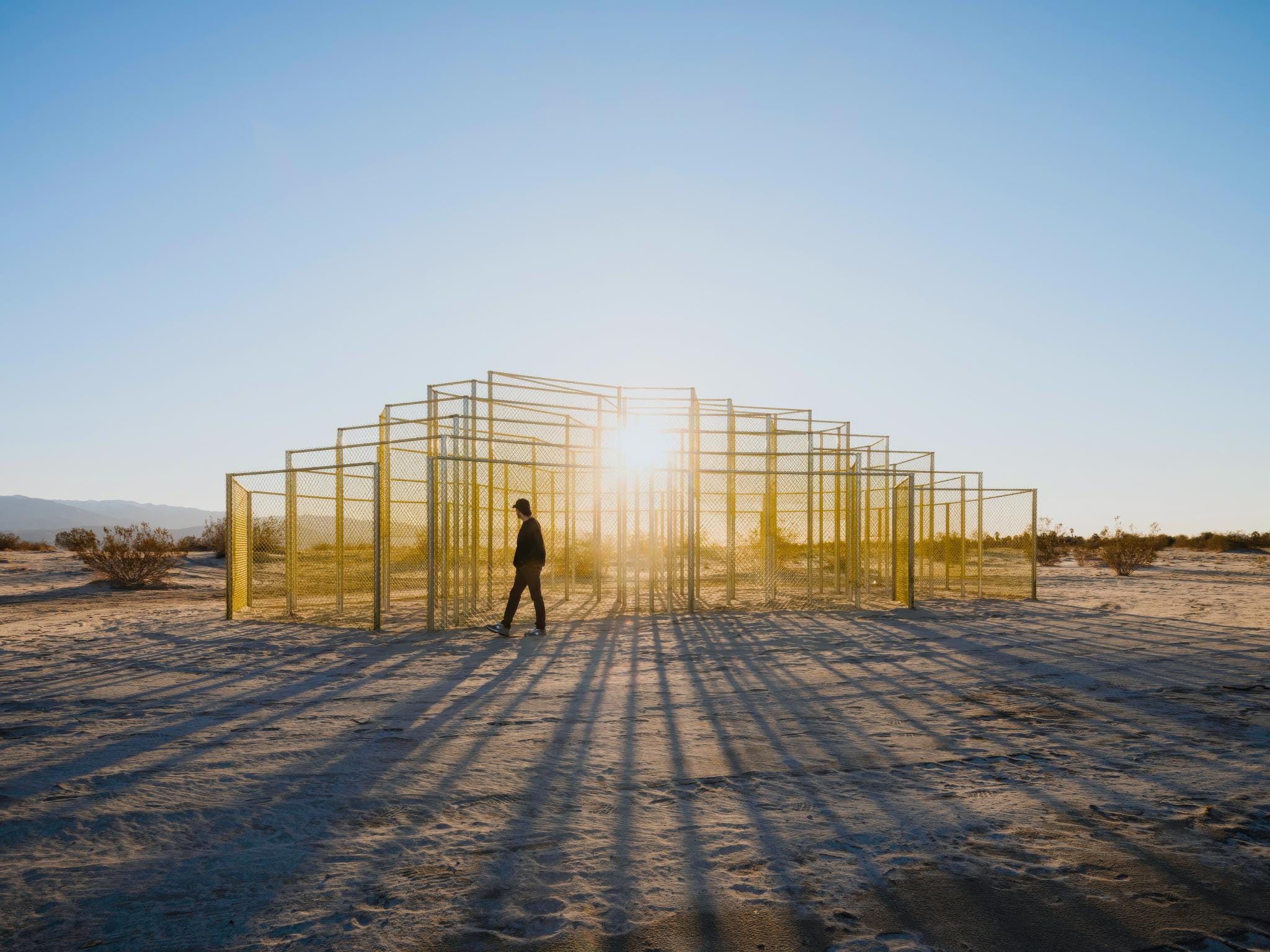
There are plenty of good reasons not to hold an outdoor art exhibition in the desert. It can be brutally hot in the day and freezing at night. Winds can top 200 km per hour. A host of scary creatures call the desert home and would be justified in attacking art tourists. Those same tourists also might also cause irreparable harm to the ecosystem. As a resident of California’s arid Coachella Valley, Susan Davis was aware of all of those factors when she founded Desert X, the world’s first desert sculpture biennial. Call it instinct or vision, Davis sensed the challenges could be overcome and it would be worth it. Her confidence came in part from a visit to the Cartagena Biennial in Colombia, where the artworks are integrated into the urban environment. That experience so moved the former art history professor that she convinced her desert community back home they could do something similar in their own backyard.
Most people know the Coachella Valley for its namesake music festival. Held each April, that two-weekend event attracts an estimated 250,000 attendees to this remote locale near Palm Springs, about a two-hour drive from Los Angeles. The 2025 edition of Desert X attracted around 400,000 visitors over the course of its 10-week run. There is some crossover between audiences, but Desert X attracts more interest from the people who live and work full time in the area. With the sculptures scattered throughout the Coachella Valley — which is about 80 km long north to south, and 32 km west to east — Desert X is particularly conducive to visitors who are able to travel to different sites over multiple days. Its natural setting and contemplative vibe also make it more welcoming than a music festival to families with kids and people with pets.
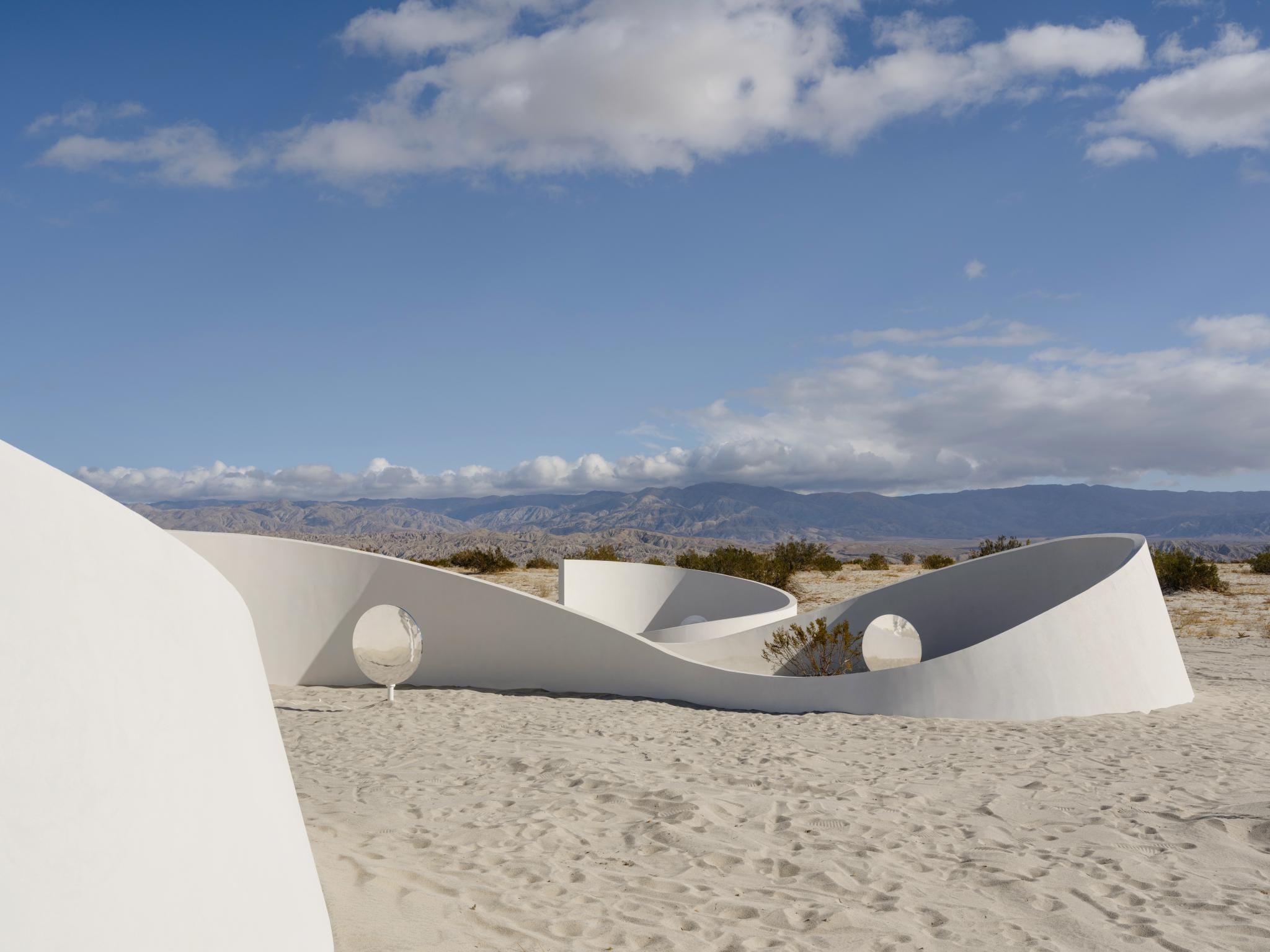
Not that Desert X is any less spectacular than its musical cousin. But instead of a fury of sound and celebrity, the spectacle comes from the curiosity of esoteric forms inhabiting a dustbowl wilderness. Jenny Gil, Executive Director of Desert X, is part of the team responsible for selecting those esoteric forms and overseeing how they are built, installed, maintained and removed. Gil explains that for each edition of the biennial, new curators are brought on board who, along with Artistic Director Neville Wakefield, invite a whole cohort of artists to visit the valley and propose installations for specific sites: “I always tell artists to pick three sites and tell me which is your preferred one, and your second, and third, because we do not own any of the land where Desert X takes place. It is all a negotiation.”
Everything is political
In that sense, every aspect of the exhibition is political. “We are going into the community saying, this artist wants to do a project, basically in your backyard or on this land that has been empty for centuries. We work with the local tribes in order to evaluate the cultural sensitivities of the lands where the exhibitions take place. Then the other major consideration is environmental. Obviously, everything we do as humans has an impact on the environment.” The team works with different organisations in order to mitigate the environmental impact. They do not work in sites that are environmentally fragile or close to sensitive or protected areas. They work with environmental design agencies to construct temporary access paths for viewers, from wherever they park on the side of the road to the artworks. They work with artists to install the works and remove the works in ways that, according to Gil, often leave sites better than they found them.
“A lot of the lands used for the biennial are not regularly maintained, says Gil. There is a lot of trash in the desert.” Gil and her team also organise a lot of public programs that educate everyone involved about the desert environment. “We invite botanists to speak with artists about the environments where the artworks take place. So we really strive to leave no trace after the exhibition and to leave the sites as if nothing had happened there.”
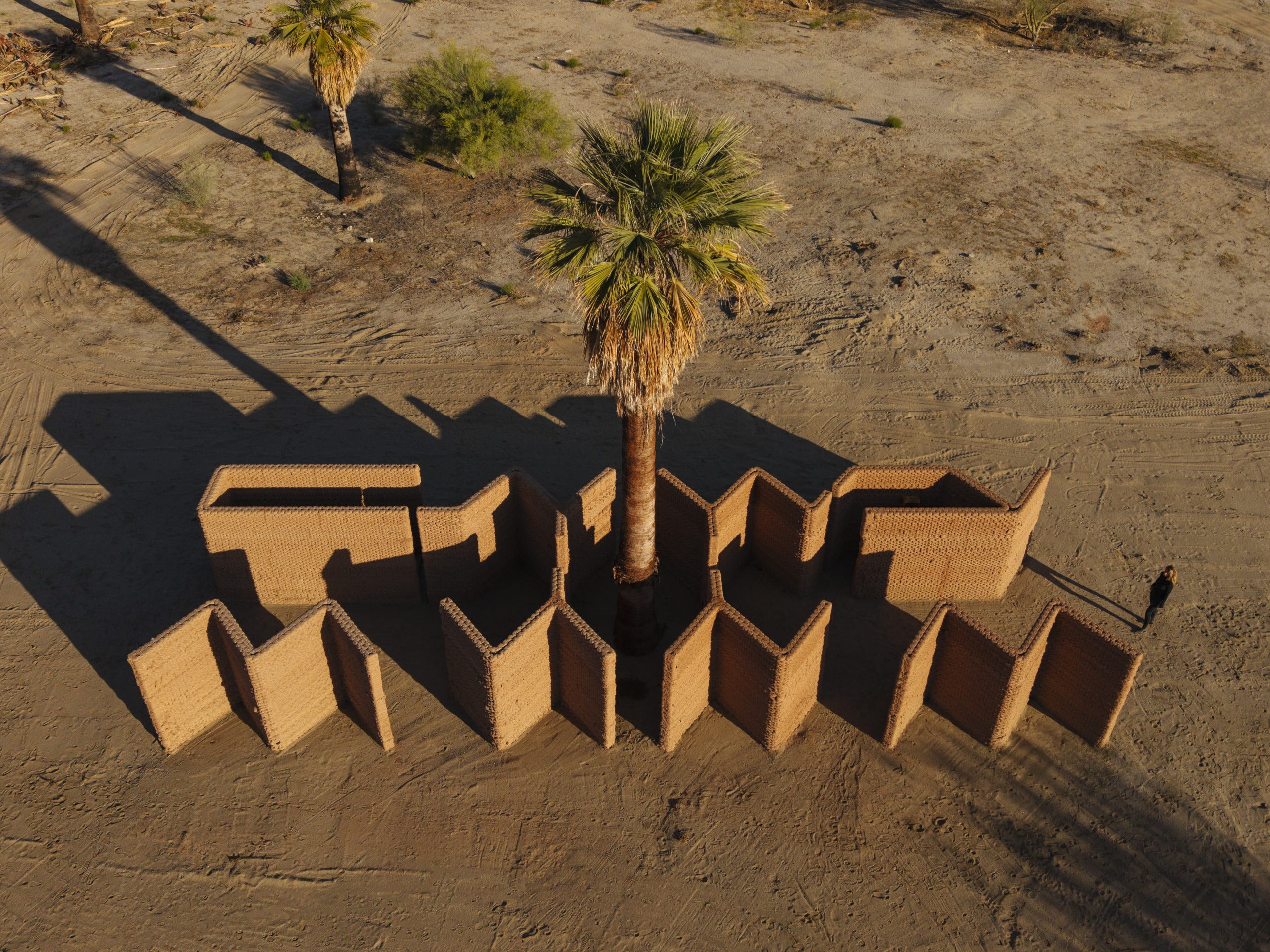
Those parameters can be challenging for many artists, especially if they are used to developing their ideas in isolation in a studio, then simply planting the finished works in a gallery or a museum. It is one thing to negotiate with a fabricator, a collector or a museum board. It is another to negotiate with a natural environment on the scale of a desert and to ensure every material and technique used is non-toxic, culturally sensitive, stable enough to survive two months exposed to extreme elements and yet ephemeral enough that the work can be removed without a trace. Some works from past editions have been fully biodegradable or otherwise disposable in an environmentally neutral way. For example, Eduardo Sarabia’s installation The Passenger for the 2021 edition was completely made from organic palm fronds. Or Ronald Rael’s sculpture Adobe Oasis for the 2025 edition, which was entirely made from 3D printed mud.
“We have had many unrealised projects, says Gill. For example, last year we invited 25 artists to come and visit the Coachella Valley. Curators took them around for about two or three days, sometimes a bit longer. They discovered the valley. They researched topics or people or organisations that they were interested in. Then they went back to their studios and came back with a proposal. We received back more than 20 proposals. We pay the artists for this process. Then we started value engineering the proposals to see what can be done. We worked with our production team that includes engineers and architects and project managers to figure out how these projects could be realised and whether they would sustain the very difficult conditions of the desert, which we do not control. The temperatures are extreme. Everything needs to be built for 210 km per hour wind. We are also very close to a lot of seismic activity, right on top of the San Andreas fault. So yeah, there are a lot of unrealised projects, not because the projects were not good, but because not every project is possible.”
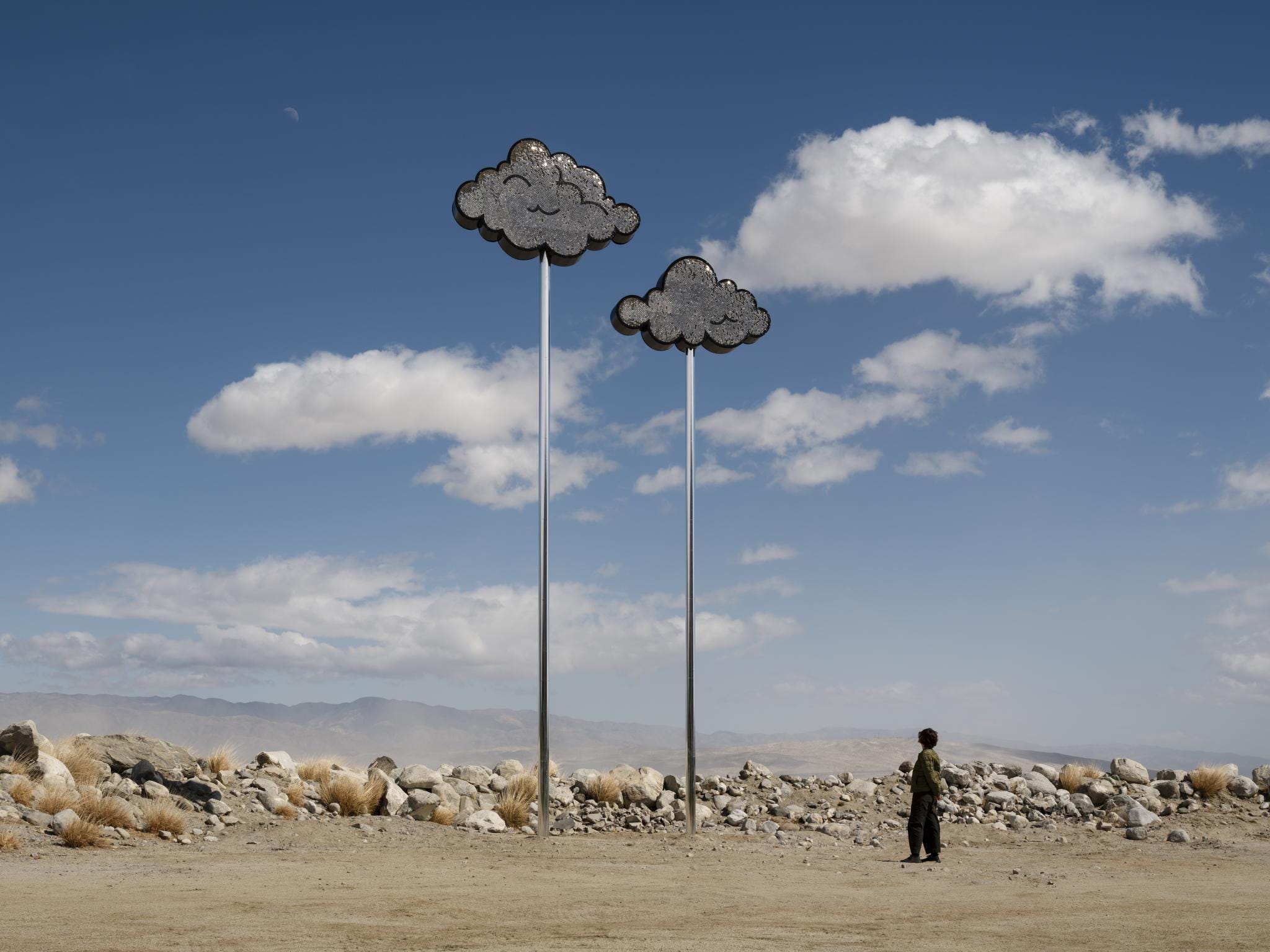
There are also financial realities to consider, since they do all their own fundraising each year. A lot of proposals are amazing in a conceptual sense, but would cost hundreds of thousands of euros to realise. “We are a temporary exhibition, so you know everything needs to be scaled to the desert conditions, but also the temporality of the show.” There are occasionally works that have the capacity to have a second life after the exhibition, although as with all site specific sculpture that is the exception rather than the rule. Nonetheless, some can be disassembled, then reassembled later in another context, such as Unsui (Mirror), the cloud installation Sanford Biggers made for the 2025 edition, which has been re-installed in Paepcke Park in Aspen for the summer of 2025. A work also sometimes lends itself to acquisition by an institution. Such was the case with Jeffrey Gibson’s sculpture Alive!, which debuted in the first edition of Desert X and is now permanently installed in the sculpture garden of the Palm Springs Art Museum.
Desert X Al-Ula
Gil and her team have faced a slightly different set of challenges with the Saudi Arabian iteration of Desert X, which will open its fourth edition in January 2026. It takes place in Al-Ula, an ancient oasis city in Saudi Arabia’s Medina Province. “Land ownership is very different in Al-Ula than in the Coachella Valley, explains Gil, but there have still been negotiations. In 2020, the first year, some of the lands the artists and the curators had identified for works to be shown on were being used by camel farmers. These people are just, you know, minding their own business, as they always have and suddenly they are being approached by an artist who is talking about seemingly crazy ideas and projects that no one has asked for.” Although they work with a local partner in Saudi Arabia that helps organise the exhibition, those types of negotiations have still not been easy Gil says.
The impetus for Desert X to expand to Saudi Arabia came from a Saudi artist who attended the first edition of Desert X in the Coachella Valley. Gil recalls that he was amazed by the project and came to them and said he wanted to find a way to do a similar project back home. That same year, 2017, Saudi Arabia happened to create the Royal Commission for Al-Ula, which was given the mission of preserving the history and developing the future of the ancient site. Tourism and cultural offerings were central to the organisation’s plan. Three years of negotiations and conversations later, the first iteration of Desert X Al-Ula opened with the participation of 14 artists. “It became a huge motor of cultural exchange between artists in Saudi and artists outside of Saudi.” About a third of the artists participating in Desert X Al-Ula are Saudi. Another third are from the larger MENA region and the rest are from other countries abroad. The most exciting part for Gil is that the artists are meeting in person during installation and at the opening. Saudi artists are interacting with artists from outside the region and Western artists are discovering immensely, highly qualified Saudi artists with whom they were not previously familiar. There is also a transfer of values happening. For example, the artist contracts being used in Saudi Arabia are modelled on the California contracts and there is a gender balance represented in the curation. The Saudi edition is free to attend, just as it is in California and there are also educational programmes being offered for the public.
Asked what advice she would offer to anyone else out there in the world thinking of organising a desert sculpture exhibition, Gil laughs and says, “Just do not!” She then smiles and develops: “If you are going to do it, spend time in the community first. Make sure what you want to do is relevant. The first thing you will run up against is push back, that nobody wants this. In the initial phase of the first edition of Desert X, that is what it was — just, why are you doing this? Why are you bothering us with this? And we still get that now. When we go to permit offices, local government organisations where we need to get a land use permit or a building permit or events permit, the first answer is always ‘no, you cannot do this’. Often the reason is because it has never been done.”
The most visible recent example of this was Ronald Rael’s project Adobe Oasis. Rael is an architect and an artist, and he is apparently the first person to 3D print a structure with adobe. “He is really challenging these traditional technologies with contemporary and future technologies, which was a huge challenge at the building and permits office at the City of Palm Springs, because there is obviously no precedent for 3D printing adobe structures, explains Gil. So how do you issue a permit? How do you make sure you know that it is within the code? And how do you make sure that it is going to be safe? So usually the answer is always ‘no’. And that is where the work starts.”