Originally published in AMA Art Magazine
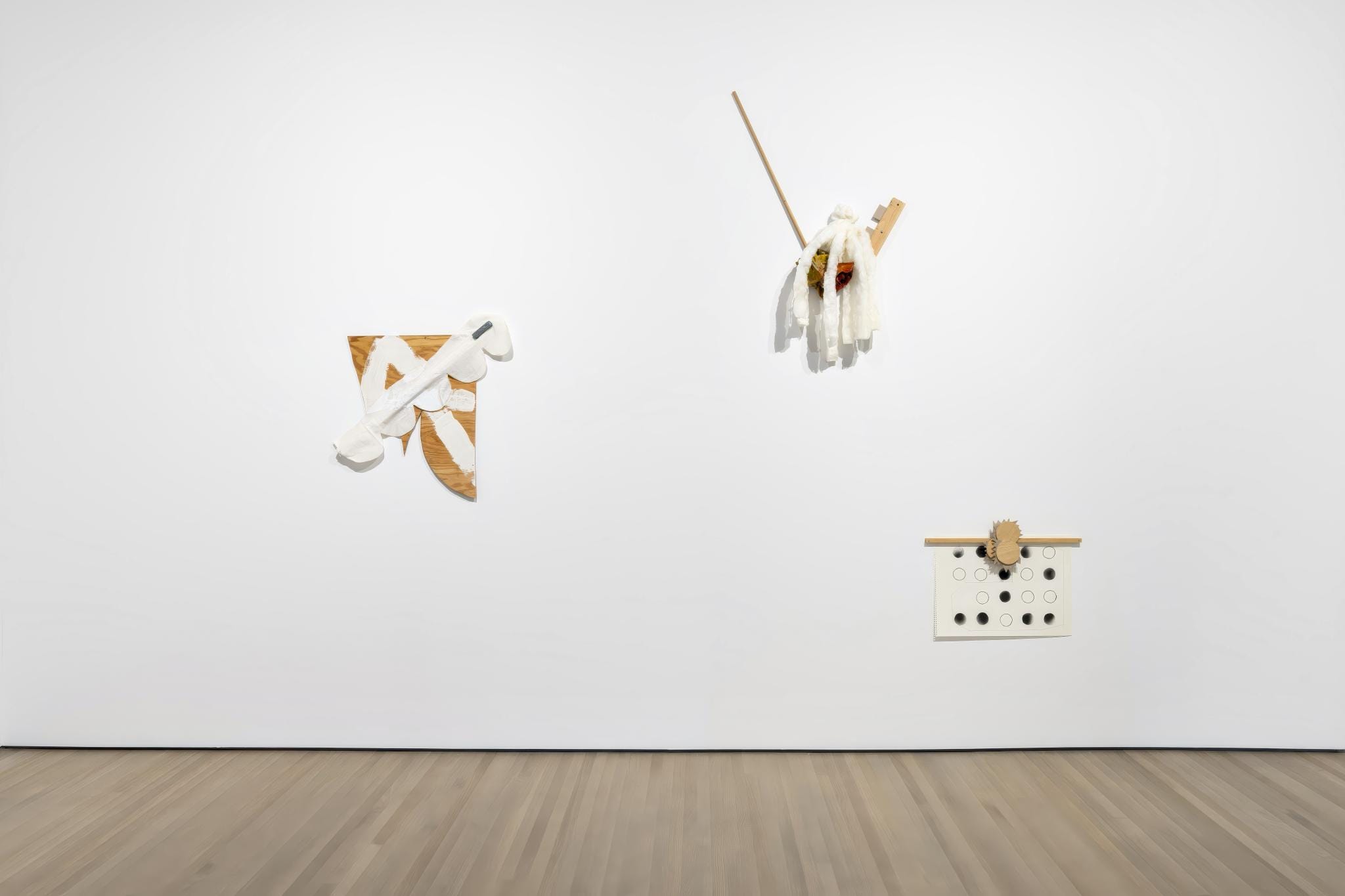
Richard Tuttle is a living legend in the contemporary art field. He has his detractors, like anyone else, but most antagonism Tuttle endures is not personal — it is just the usual derision hurled at any artist who, after coming of age during the post-minimalist, post-conceptual period of art history, when academics declared art objects irrelevant, audaciously dared to keep making art objects anyway.
Tuttle’s 10-year survey show at the Whitney Museum in 1975 gave critics fits. The most divisive works in the show, Tuttle’s Wire pieces, were also the most subtle. To make them, he hand-drew simple graphite lines on a pre-lit wall, traced the lines with a thin piece of wire, then the wire sprung free, creating a third element — a shadow. Reviewers trashed them as sparse and minuscule, unaware that that only demonstrated their understanding. As Marcia Tucker, curator of that exhibition, recalls, “what people criticised about the work was very often the thing the work was about.”
Tuttle continued following his ideas wherever they led, and 50 years on his exhibitions still feel nuanced and challenging. His commitment to creative independence has made him an enduring influence on successive generations of younger artists. Meanwhile, the aging process has him feeling freer, and he says “purer” than ever. As he explains during the following interview, “There is a whole registry of old art from older people that can be the best art there is. I think what makes this happen is that things are peeled away.”
What are you working on right now?
Art is curious. I think it is the first invention of humans, homo sapiens. It precedes the immune system for example, which a lot of people think was the first thing necessary to make us viable. An ingredient in artwork should be a remembrance, or acknowledgement of, or connection to, the origin of art, for us. That cannot help but be beneficial, especially when we are challenged by environmental and health issues and changes of mores and values and so on. If your values come from art, you cannot be far off the track. Although we know art’s values can be polluted as well. It is a game, so full of contradictions. Getting old, I think, can be a good thing in terms of art, because you have to peel away a lot of impediments and, in a way, you get “purer”. I feel full of contradictions, but as I develop as an artist, I want to become more and more what I was born to be.
How can you talk about “development” if you are trying so hard to go back to such a beginning? I think it is fully understandable. I find it very useful to think that artists are born. It is not a question of nurture at all. Nobody would ask to be an artist if they knew what it was. You would never be an artist unless you were born to be this way. Being born this way, has a characteristic that you are absolutely ambiguous about everything. Nothing you experience, or can say, does not have an equal and opposite place or validity in your mind. Because of this, you are always trying to make a unity. One characteristic of art, whether it is Western, or recent or old, is that there is a unity that happens in a made thing.
When I think of this notion and the current work, what I am trying to do is extremely experimental. I find, as an artist, I have been given two kinds of time: linear and circular. One, the linear, does not have an end or beginning; and one, the circular, does, where the beginning and the end are the same. As a four-year-old, I understood my linear time. Just recently I have understood my circular time. They of course are quite opposite. In terms of making a picture — which is a unity — can one, or is one called upon, to attempt to make a picture that unifies these two kinds of time?
What do you mean by “picture”?
“Picture” is a word that was disparaged in my youth. My first dealer, the great Betty Parsons, used the word in a particular way. In those days art was a religion where you had to learn a catechism in order to practice. Recently, I find I use the word if I make a statement, like, I am somebody who needs a picture to live my life. The better the picture, the better I can live my life. Whoever gives me a better picture, I am enormously grateful to. I find, to know what we think, to know the self, is a very difficult thing. We will hide things from ourselves, maybe even for very good reasons. That does not help the artist when they are trying to make their picture. It may for a certain period, but in the long run — when you are a “senior” artist — your work becomes a lot about creating tricks to flesh things out what might be deeply hidden, or obscured, that get in the way.
In preparing for our talk, I sketched out some notes. One of the things I wrote down was from Aristotle. His two “go-to” points were: necessity and better. He said, if you want to understand nature, you have to understand how nature operates. It is, he says, either because it is going towards something better, or because it finds something a necessity. What jumped into my head is: this is analogous, i.e., that in your senior period nothing can be hidden. That what we have is a pure issue of necessity. I find it amusing, younger artists can work toward better: I want to make a better picture, a better cover, a better presentation. Then, there is a shift somewhere, where “better” turns into “necessity”.
What materials are you working with at the moment?
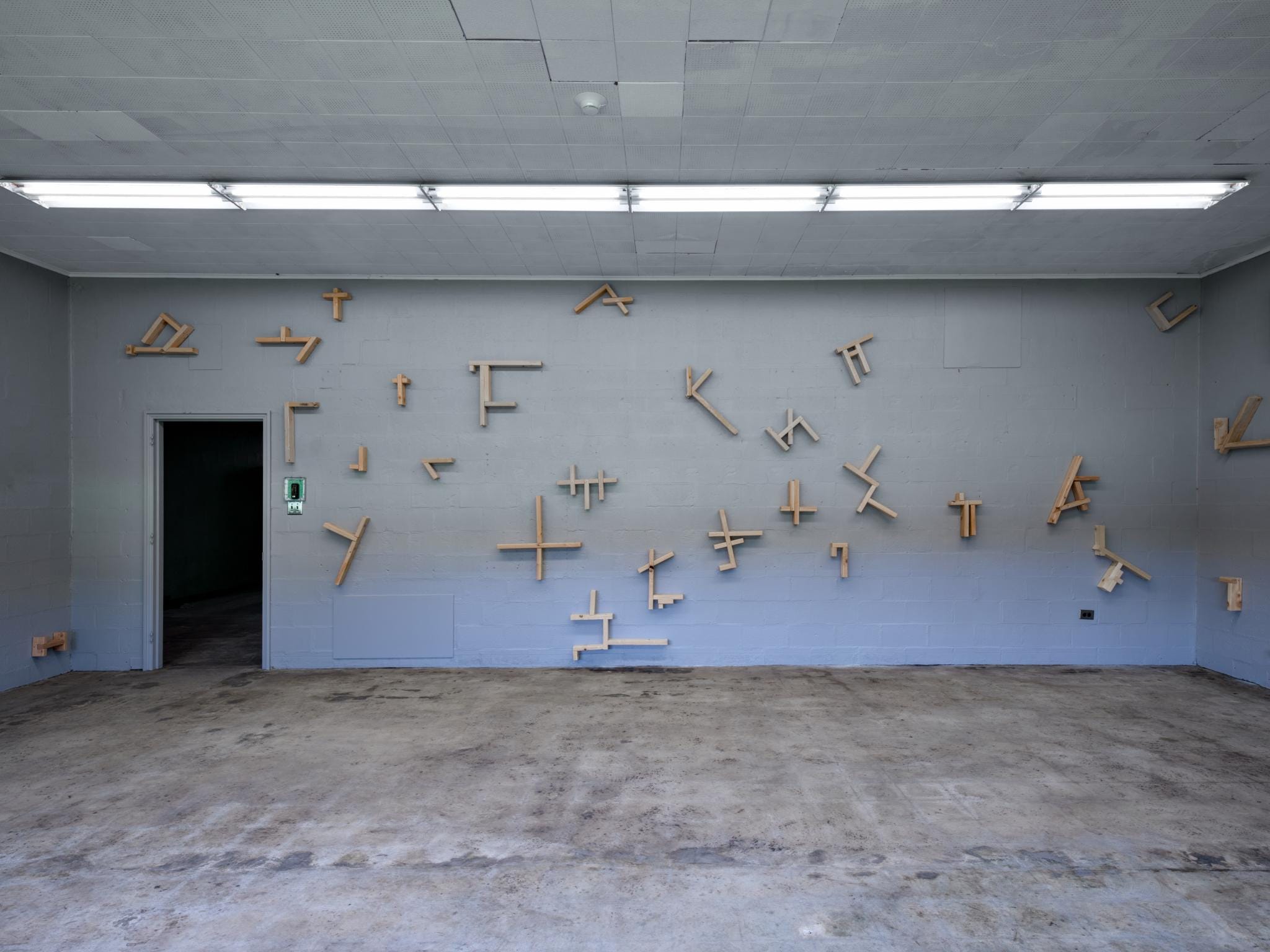
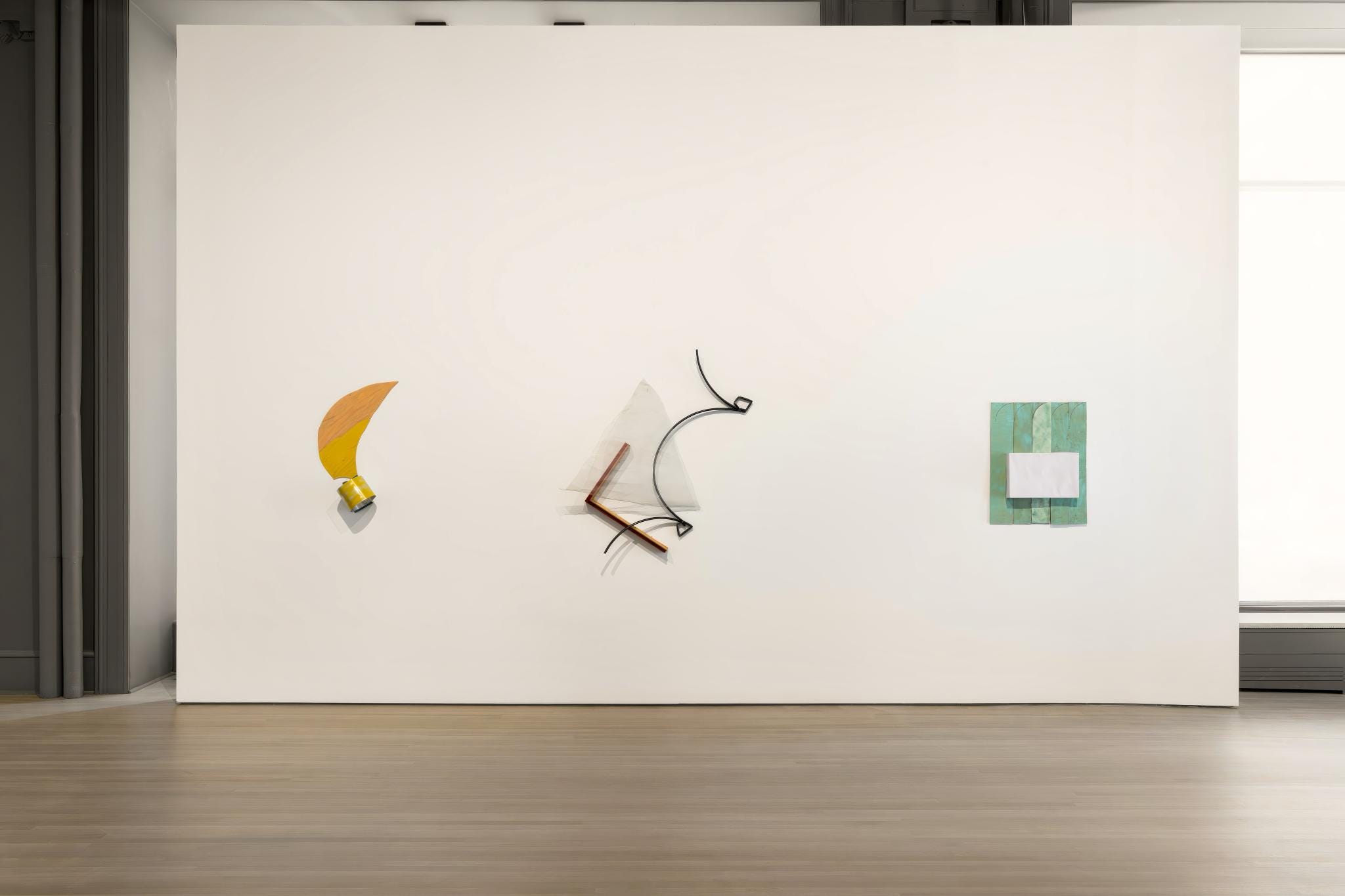
I am back into the notion of canvas. The colour of canvas. That fits, because I am showing, right now, a group of works at The Campus upstate in Hudson, New York. Long story short, I did a room there. The pieces, 58 of them I think, are all made of 2 × 4s. I made them in New Mexico. They are extremely simple, embarrassingly simple. I wondered whether they could be anything worth looking at. In the end, it could be, all those pieces are a single work. I like that. There is an aspect of an alphabet, or letters. For example, take the letter “F”: how interesting is that to look at? Maybe, its interest lies in the fact of reading it and the simultaneity of reading it and looking at it, which is, oddly, a concept close to the Mayan alphabet, where the writing system allows three different experiences simultaneously to its reader? Whereas ours strives for one “correct” experience — which I think is unfortunate. A lot of my work has an aspect of writing, or the verbal world, attached to it. Not in a Greek kind of way, or a Magritte kind of way, or an Abstract expressionist kind of way, but as a signal of new pursuit.
The Campus exhibition happened after making these 58 pieces. As I came to understand, they must be on a grey wall. When I saw them there like that, I saw two wonderful things had happened. The grain of the wood resembles and even is you could say, the same as my natural, drawn line. One of my battles, and my generation’s battles, is to free the relationship between identity and image, of which there is nothing wrong, except that it has been used and abused in the world to the detriment of what we might consider “good” art. Not being judgmental: anything is good. A tree is good. Ground is good… and so is art! It should be good, like a tree should be good. I enjoy doing what I can to feed and nurture a tree, so the same with art. The second important thing that happened in The Campus show is that the colour of the wood took over the job of colour. That is very thrilling to me, because in sculpture — and it does not matter whose cultural lineage it is in, or comes out of — sculpture can be divided between polychrome and not polychrome. You can have sculpture that is part and parcel with the actual world of colour and you can have sculpture that is not. That is an extremely interesting phenomenon we have in front of us as sentient beings. It is also a division. When you put that division in front of an artist, whose job is to unify, they are going to, from the bottom of their souls, do what they can to unify it.
In the case of this exhibition, the decision to put them on a grey wall, brought out the division between polychrome and not polychrome. Polychrome does not mean paint, it means colour. In this case, the colour comes from the wood itself. This is coming from a kind of energy that is free. When the people look at this, consciously or not, they partake of this freedom. It can be added to the social toolbox of good things. Principally, it shows that art is good. Now, I am being very theoretical, i.e., because it is the first thing that was invented by homo sapiens, how could it not be good? Here is another paradox the artist has to wrestle with — the good in themselves and in art, cannot be known or investigated. You cannot know more about them than you already know.
What role do opposites have in your work?
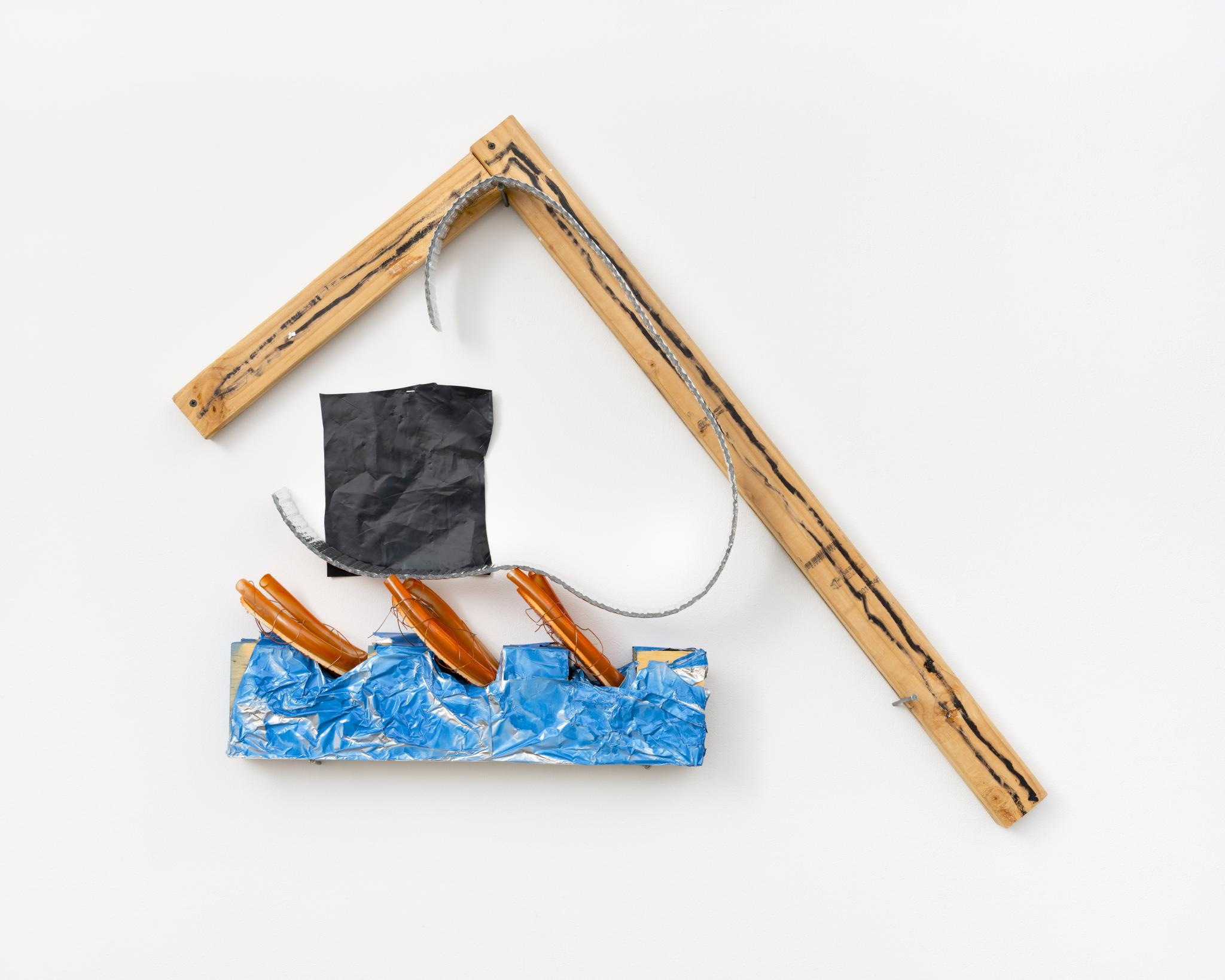
I am open to contradictions, yet I am a nut for the truth. I mean the truth of art. The world is always looking for some kind of scientific truth. Art can never supply a scientific truth. Philosophy looks for something that cannot be contradicted in any way. Art looks for something that cannot not be contradicted. In a book I am reading, the author quotes a poet who said that a poet has to offend their fans, has to figure out who their fans are, and then must offend them in order to keep on writing. Is that not interesting? You say you are happiest when your editor approves of your writing. What about the opposite? When you offend your editor, then you are free and you can write the way you want to write. One of the starting points of my work looked like islands. I would take a pencil in my mouth and bring my thumb and forefinger together and trace that shape on paper and then put out linings of watercolour around the shape. It looked to me like an island. John Donne said: “no man is an island”. Others say, you are not happy unless you become an island. I think I do not believe in the opposition. For example, you can be shaped by early experiences in life, shaped by certain darknesses that will become what you think life is, that the pain that you experience: that is life, even to the point where you will look to painful situations when looking for life. This is a darkness. Or, like even where I am in Maine right now, and we have the spectacularly beautiful light in August and early September. It is so clean and so pure. I know as an artist that there is a dark, a pit that is part of what light is.
Another book I am reading this summer is called Wild thing. It is a recent biography of Gauguin. This period of Post-impressionism, which was not that long ago — Gauguin was a contemporary of James Joyce, for example, and of relativity theory — all this stuff was happening at the same time, Schoenberg was writing music. Anyway, what happened with Gauguin and Van Gogh was a kind of mannerism, where, like Pop art, the image comes from back to front and the viewer experiences it in a sort of smash — it smashes into us. Van Gogh understood deeply Cezanne’s art, and employed the gist of his art making. Gauguin only half understood it, so was less successful. I love Gauguin’s work, but it is flawed, because his understanding was flawed. This is always beautiful, because he achieved what needed to be achieved, but shows us he did it despite his flaws. As an artist I think this is very important, because this is the other thing about painting — that it is a unity and it has to be a unity, but there is no such thing as a perfect painting. There is something wrong with every painting. For people to have art in their lives, they have to accept, something can be a perfect unity and still have something wrong with it.
Does art in your life help?
Art helps your life if you are the kind of person who can walk down the street and feel good, knowing that you have experienced an extraordinary unity. In art, the artistic is challenged more and more by making unities out of the greatest disparities. This is why I am working with two kinds of time which absolutely will not coexist in the world. Yet this is a perfect field for art to become involved with and attempt a unity. The wonderful thing about art is, success and failure does not matter. Even if you succeed commercially, it is not success, in that way. It is only another artist, who knows if you succeeded as an artist. This is something certain artists know and they really work toward the recognition of other artists as their shield, the shield of success of art, to earn the shield of success in art, rather than in other devices. The depth of the materiality of art culture is so enormous, there must be something else than just material things.
On that topic, what are your thoughts about artificial intelligence and art?
I think we are sort of winding things up. I was invited to Notre Dame. They have an advanced studies program at the university, and there was a panel about creativity. A respected and famous psychologist from Denmark had a residency there to write a book about creativity. He chose three or four creative people to explore and investigate in order to produce a general theory. One of them was Agnes Martin, who was an important person — is an important person — in my life. She has passed on, so I was invited to come and speak about her. Long story short, the psychologist and I fought a fierce, enormous and basic fight. I said, he should throw away his book, and when he understands something about art, he should try again. The moderator of the panel was a remarkable man, who was a lay, Dominican priest. He did not say a word during this panel. Afterwards, I thought to write to him. My question was: “You experienced all of this, you did not say a word, I gave everything I could to you. Now, I want to know what you saw going on?” His answer was, “I saw a classic battle between the scientific and the humane, where the scientific believes in repetition and the humane does not.”
This, for me, signals some part of the thing we are addressing. When you are living in this frenetic, everyday world, as you are, you do not have the perspective from which you can see life. One of my jobs as an artist is to make something, so some can actually see what life is between their birth and death. I was a resident at the Getty during a year that was supposed to be focused on colour. Dredging the bottom, coming up for air, I made a book for them titled, You never see the same colour twice. You know, our scientific-based civilisation operates on the idea that you can see the same colour twice — all these paint chips. I can go on. Western philosophy is hobbled and has nothing to say when colour is brought into the discussion. This same civilisation claims that we can see the same colour twice. Ok, so as far as AI is concerned — and a lot of other technologies — it is based on “you can see the same colour twice,” i.e., this “scientific” position, which is based on repetition, that cannot be proved and diminishes life. At the very least, there should be an alternative in our lives — a possibility where the reward is life.