Originally published in AMA Art Magazine
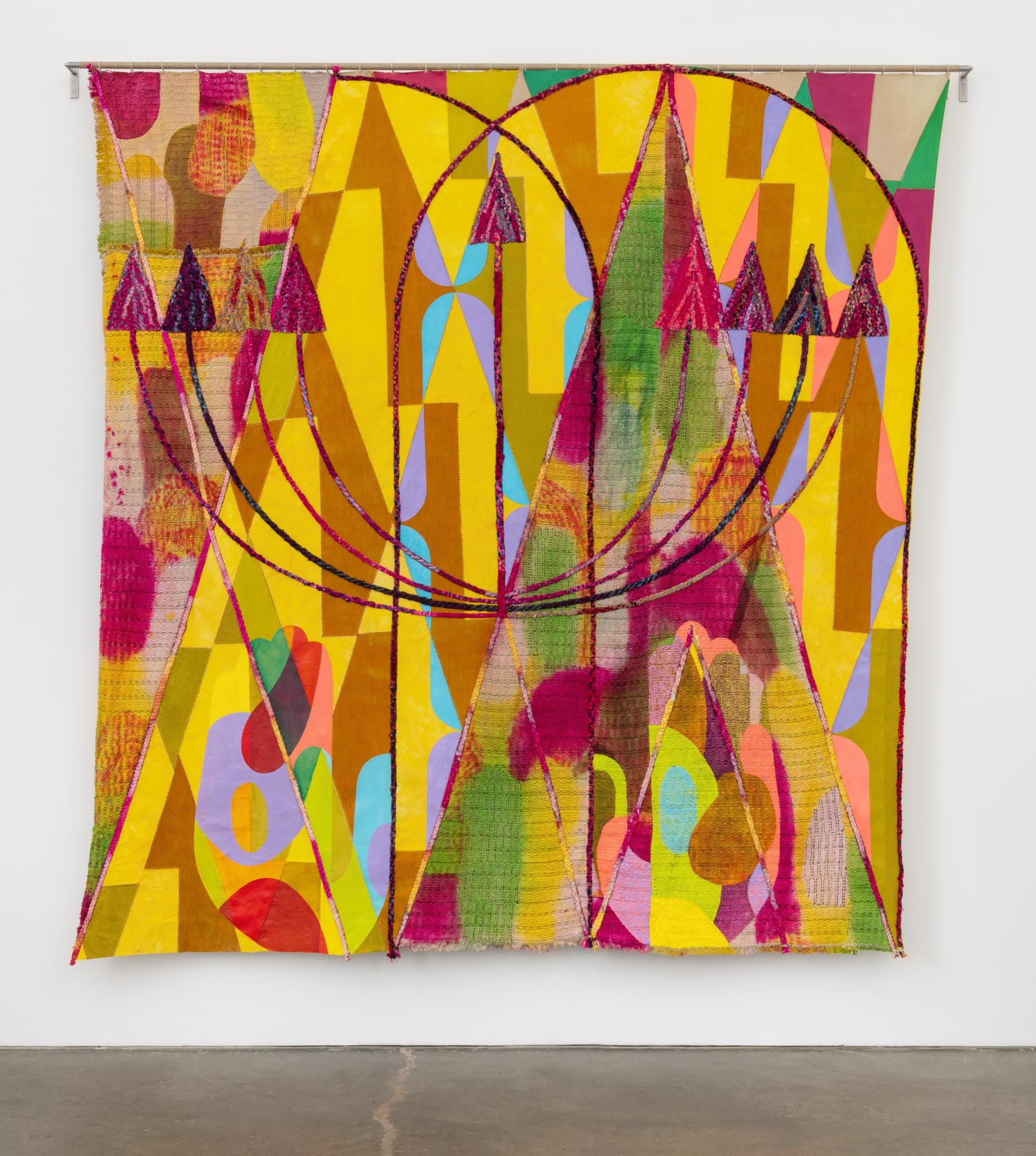
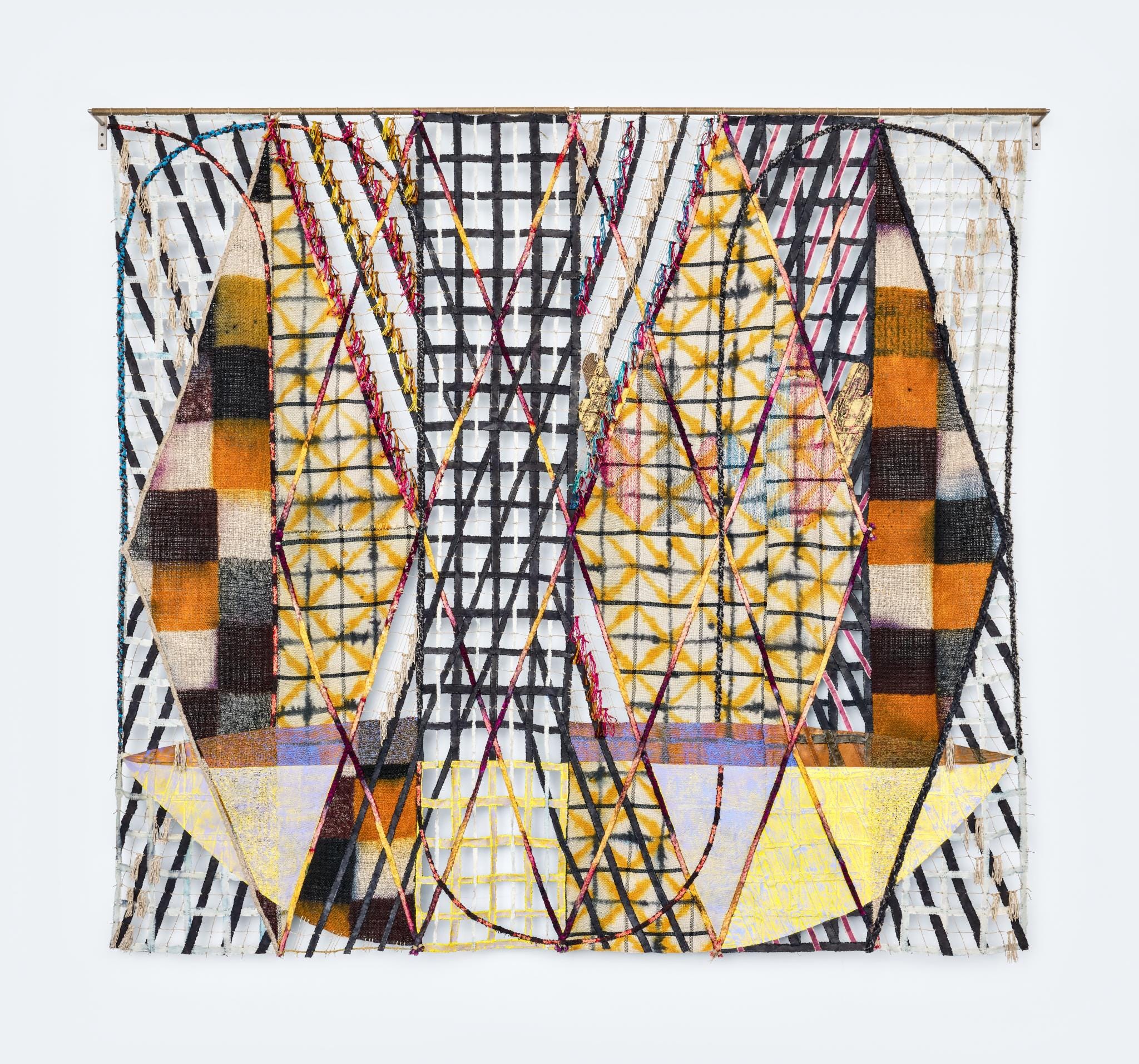
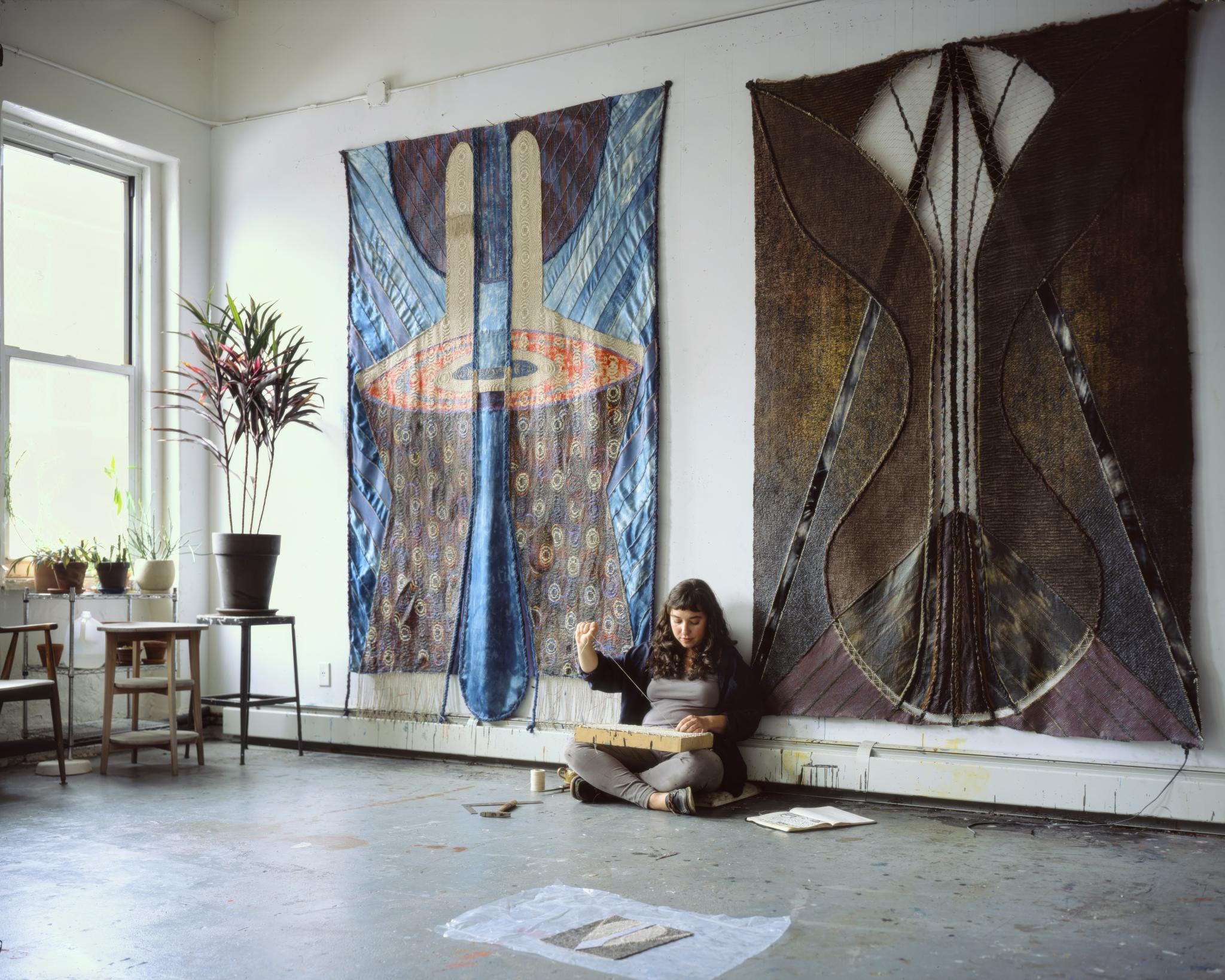
Julia Bland’s weavings are visual marvels — cords and yarn, plaits and twists, woven, sewn, painted, tied and dyed by Bland in her New York studio. They are fragmented mental mirrors for us to reflect upon. They have multiple centres, and no centre, exemplifying Bland’s interest in the Gestalt shift, a phenomenon when one’s understanding of something suddenly changes because of a shift in perspective.
A graduate of Rhode Island School of Design and Yale, a Pollock-Krasner Foundation Grant recipient and a former artist in residence at Yaddo, Bland’s first solo museum exhibition opened at the Aldrich Contemporary Art Museum in Connecticut in 2024. Called “Woven in the reeds”, the show featured a single, large-scale abstract weaving; both image and object; a magnification of weft and warp, the defining elements of a woven textile and a statement of Bland’s revelation that weaving is not so much based on a flat grid, as is often misunderstood; it is a more complex structure that employs diagonals and extends into dimensional space.
Bland’s next solo show will be with Derek Eller, her New York gallery, in September 2026 — it can take a year or more to complete some of her works. Meanwhile, she took some time out to answer questions about her history with weaving, the sources of her inspiration and the meaning of her work.
Abstract art is sometimes derided or diminished as meaning nothing, except that someone had the money to buy it. Can you express the deeper meaning of abstract art?
Wow. You know how to start an interview! I think certainly there are some people, some collectors, who would like to have art that is pleasing, that somebody else bought for them maybe, and that they maybe do not even look at. That is true. I do not think that is only true for abstraction. And I definitely do not think it describes all collectors who buy abstract paintings. I think that abstraction is a very deep part of culture. It sounds like that point of view is saying that abstraction is separate from culture. But it is not. Abstraction is in every culture and it is everywhere. Maybe in its ubiquity, it can become invisible, but it is a huge part of the way people think. We make a lot of assumptions about things that we are used to seeing all the time. So one of the things that abstraction can do is make you look at something closer and think twice about something that you think you understand. But that is in the hands of the viewer, if they are going to take this step to think about something twice or rethink something that they already thought they knew.
How did you arrive at abstraction as the field that you would focus on?
There were some different points in my life where I had a big shift. Ever since I was very little, I was thinking about the surface of the image. I grew up sewing and doing craft projects with my neighbour, who was a craftsperson. Even when I was painting, I was always doing these other projects that had other materials. When I went to art school, after the foundation year I entered the painting department and then, within a couple weeks, I was working with fabric and had decided I was an abstract artist. That was a big shift. It did not mean that everything I did from that point on was totally abstract. But I knew that I was not interested in describing the world representationally. The question was, well: “what is the image then?” If it is not an image of what things look like, “where does the image come from?” I spent many years thinking about that. I still think about it. It is a never ending question, really. That was a big revelation for me. That was an epiphany. It led to seven or eight years of experimentation.
Did those years include the time you were living in Morocco?
Yes. In the years when I was experimenting, three of them were in Morocco. When I first got there, I was pretty overwhelmed because it was so different from where I was from, Palo Alto and New York. So as I was getting used to how different it was, I was not making any art. I made clothes — I made clothes to wear, because I did not even know what clothes to wear there. That was hard to figure out because it was a very traditional city that I was living in, that was very old, and I did not want to walk around like an American student, and I was not a Muslim woman either.
How did the visual environment of Morocco affect you?
I was interested in the patterns. Like abstraction, pattern is everywhere and it takes on different meanings in different places. This is something I started to think about there. There were patterns that felt really different to me, and patterns that felt similar to things that I was used to — some that were very Moroccan and yet felt totally familiar. So I was sort of thinking about aesthetics. Then I also worked for a person who carved wooden doors. We would transfer patterns onto the doors and then I learned how to carve the wood to make these relief patterns on the surface. He had a really quiet workshop and I would just sit there for hours in silence. Sometime after that I started making paintings. They were on paper with really crappy paints. They were abstract, but they were not much to speak of. I was just starting to make something again. It was just about making — making anything, you know? The people there were making tons of stuff. That is the thing. They were making their own couches, their own clothes. There were tile craftsmen, leather workshops, pottery, just tons of stuff being made. So there were all these materials. I would go buy fabric and I would buy things like sponges and beads and try to just make stuff.
Was weaving something you practised there?
Actually, when I came back home to New York somebody gave me a loom. It was random. My dad’s friend was like: “I have a loom in my attic; do you want it?” And she shipped it to me across the country. So that is when I really started learning to weave. And that really changed things. It was a huge deal because I had been looking at patterns in Morocco for years and thinking about what is the meaning of these patterns and where do they come from? Then suddenly I had this machine that made patterns, automatically. It was like: “Oh, my God, this is it! This is a machine that makes a surface and it makes an image at the same time.” It was mind blowing. That was also my step out of minimalism, where I could embrace a more rich visual language… or I was forced to.
Geometric abstraction is important in Morocco and prevalent in your compositions. Do you feel there is a spiritual aspect to the geometries you use?
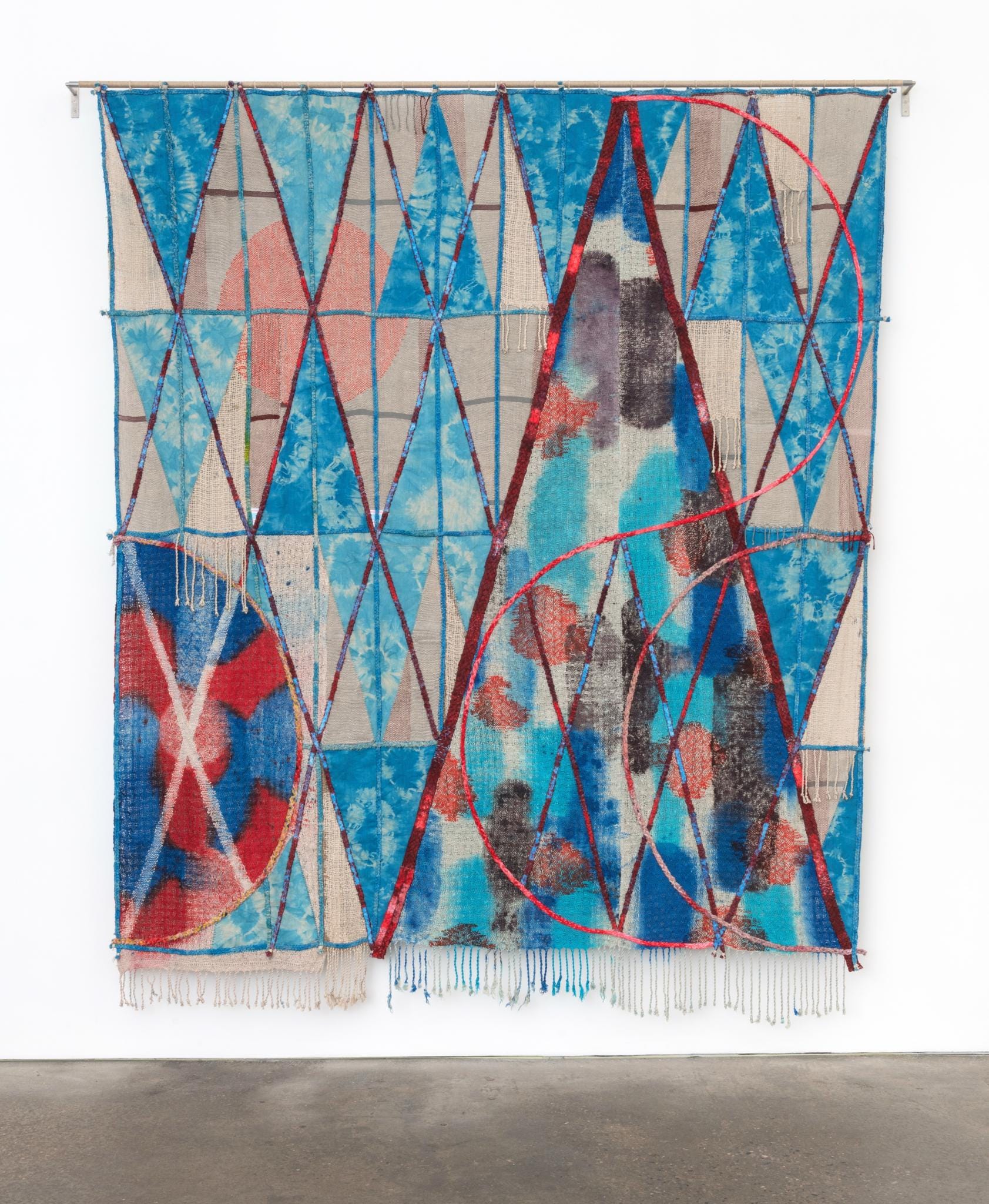
I feel like there are different kinds of abstract patterns in Morocco. There are the mosaic patterns, there is calligraphy and textile. There are all these different forms that abstraction takes. The one that I was really interested in was in the mosaics. I do feel like there is something spiritual about them. One thing I talked about recently in my show at the Aldrich Museum was this thing called the shifting Gestalt effect, which is what I encountered there. The way patterns are intertwined, there are all these different centres. You look at the pattern in one way, and you think this is the middle of the pattern and everything is radiating out from there. But then you look over just a little bit and… “no, that is the middle of the pattern now.” And it keeps shifting so that there is no centre but everywhere feels like its own centre. That was really impactful for me. It is not like there is a wall and then the art is on the wall. The walls in the rooms are all covered in that pattern. The art is embedded in the architecture. So you are moving through this dizzying array of patterns. And yeah, it feels like a mystical experience. Coming from a Western perspective, the history of Western art is the history of one person’s perspective. I am standing here, painting what I see, and the painting is of the view that I have, versus walking in a room where there is no centre. The loss of that sense of individualism, there is something spiritual to it.
In your studio, you are still one person working from a singular perspective. How have you brought that broader perspective into your art?
We always are one person making something. And I am not a craftsperson. I feel like there is some of my work where I am like an animal, making a nest or something. I am not even thinking about it. I am just interacting with stuff. But I am also the architect of all of this, in a big way. In terms of the geometry, I do try to evoke some of that broader perspective. It is not the same, but I do think about how the pattern can shift. I am working on this piece right now where I want to have these patterns that set up a certain expectation… and then move against it. But then the geometry also comes from this totally separate thing that happened for me when I was learning to weave, where I had been thinking about the grid. For a while, all the works were based off of the grid as the structure. Then it occurred to me that weaving is not really a grid. It is a zigzag. The threads are always going back and forth this way and that way, one thread in each direction. So this obsession with the grid is not real. It is just an assumption. So I started using that idea to structure some of the imagery. I did not start making a giant weaving of zigzags intersecting, but I started thinking about compositions that were based off of a continuous zigzag. Once that entered into things, it evoked all this different stuff for me and it took off in an unpredictable way. The triangle shape and the zigzag look like writing… or look like a landscape… or look like a person. It suddenly just looks like everything.
Is it important in a political sense that you are making work that is not prescriptive — that people have agency to experience it however they want?
I try not to predict or anticipate people’s experience of my work. But, yes, that is how I experience making my work and speaking with people about it. My intentions and understanding of my work can be conflicted in ways that are sometimes maddening. And I have learned a lot by listening to people responding in ways they feel are totally self evident and obvious that never would have occurred to me or to other viewers. This is fascinating to me on a human level, but I suppose it also extends to the political realm where I feel humanity is sometimes sacrificed by “us vs. them” narratives. What is most interesting to me is how vast and diverse human experience can be. Two people can be given the same information or see the same thing unfold and come to wildly different conclusions… and that both hold some kind of truth. I am looking for evidence of this as I work and I hope that others will find evidence of this in my work as well.