Originally published in AMA Art Magazine
Religions tend to organise around some variation of the question, “What is God, from our perspective?” Their houses of worship are then logically designed to accommodate whatever the believers think their deity needs in a building. Mosques feature minarets so the faithful can be called to prayer; Shinto shrines feature a Chōzuya, or fountain, so pilgrims can cleanse their hands and face before entering; Catholic churches contain consecrated altars containing at least one first-class relic — a body part of a saint — echoing a time when sermons were delivered atop the graves of martyrs.
But what if a religion teaches that all other religions are correct — that God is everything they all say God is, and more? Could any house of worship ever be designed that would accommodate everyone worshiping everything they think God is, all in the same place, all at once?
That is exactly the challenge faced anytime someone designs a Bahá’í house of worship. Bahá’í is a messianic religion that preaches that all other religions are also true. It was founded in Iran in 1844. That was the year its first central figure, Alí-Muḥammad (1819-1850), changed his name to The Báb, an Islamic term for gate, and proclaimed he was a manifestation of God on Earth akin to Moses, Jesus and Muhammad. The Báb’s writings (along with those of his professed messiah Baháʼu’lláh and Baháʼu’lláh’s oldest son Abdu’l-Bahá) form the canonical texts of Bahá’í. In addition to teaching that all religions are born of the same source and all religious people worship the same God, they call for humans to strive for spiritual unification in order to make life materially better for everyone. Houses of worship are a central part of that mission.
The first Bahá’í temple was constructed in Ashgabat, Turkmenistan, in 1919. Its design incorporated minarets out of respect for local Islamic architecture. It was damaged in an earthquake in 1948, and was later demolished in an act of iconoclasm. But since then, every new Bahá’í temple has similarly been designed so that it respects preexisting local architecture and fits in with the natural environment. As such, each is unique. Yet, all Baha’i temples do share one design principle in common: they have nine entrances, a nod towards what the Bahá’í consider the nine “major” world religions — Bábism (the original religion that was founded by The Báb), Bahá’í, Buddhism, Christianity, Hinduism, Islam, Judaism, the Sabians and Zoroastrianism.
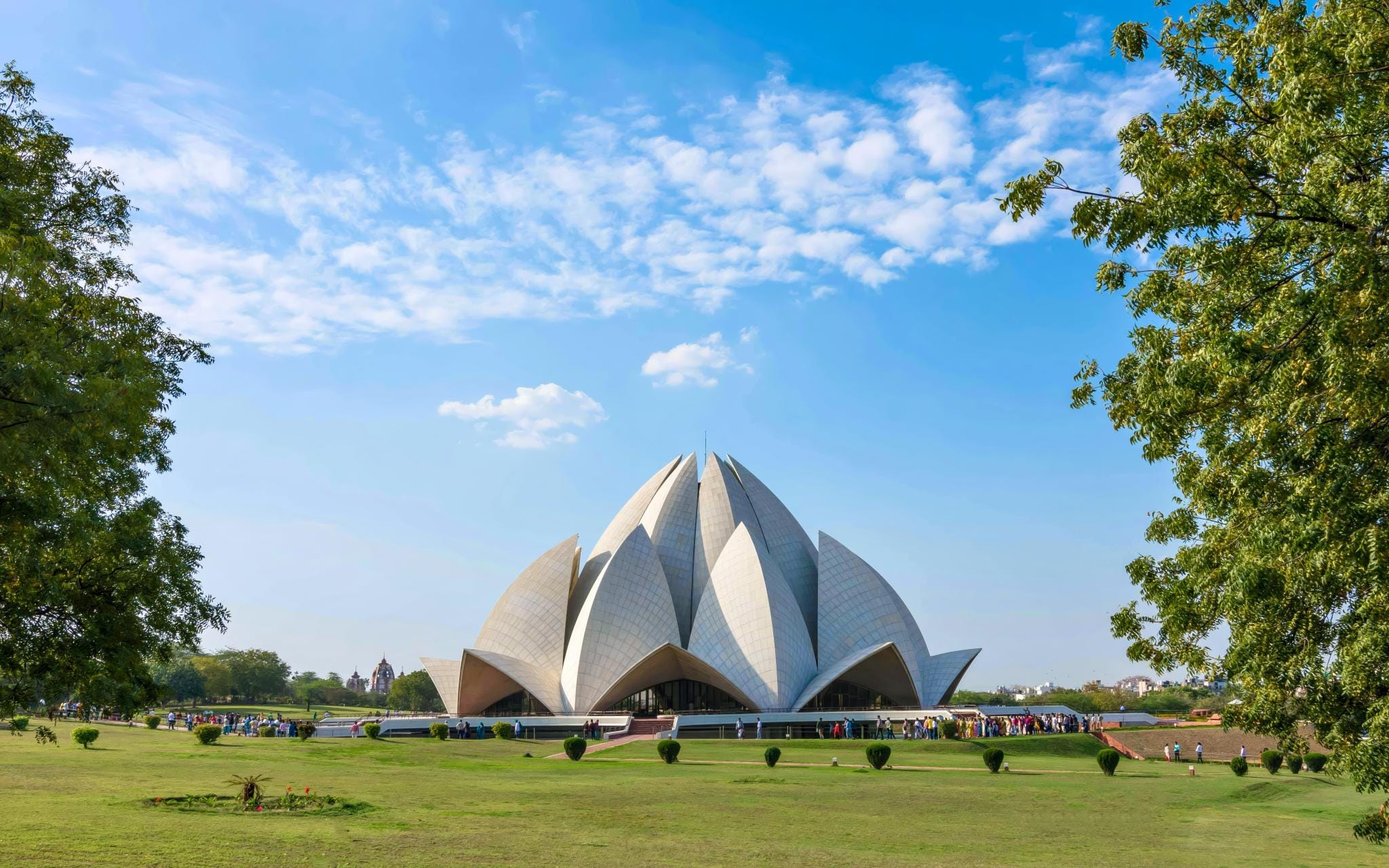
As of 2025, there are 15 Bahá’í houses of worship around the world. The largest and most famous is The House of Worship in New Delhi, India, also known as The Lotus Temple. 34 metres high and 64 metres in diameter, it can seat 2,500 people — more than twice the capacity of the second largest Bahá’í temple, in Wilmette, Illinois. The Lotus Temple takes its name from its shape, which includes three concentric rings of nine giant petals — 27 petals in all. Each petal was first framed in wood, then formed from poured concrete and finally covered in Italian marble. A ring of nine reflecting pools surrounds the main structure, which is cooled by a system that funnels air over the reflecting pools, through underground chambers and into the temple.
An impossible dream
The Lotus Temple was the dream of Iranian-born architect Fariborz Sahba, who was first approached by Bahá’í church leaders to design a temple for India in 1976. At the time, only four other Bahá’í temples existed around the world. Sahba studied their designs, then traveled to India to get a sense of the character of the location. While searching for inspiration, he met a man who inspired him, “an ordinary Bahá’í, Sabha recalls, who came because he heard that I was going to design a temple. He said he was curious about what I was going to do and then he mentioned to me the lotus. I was impressed by his enthusiasm but the concept itself did not attract me. Yet… everywhere I went I saw the Lotus in front of me. I could not escape from this concept. I was seeing it everywhere.”
The lotus is indeed ubiquitous in Indian architecture and design. It is also appreciated in many other cultures, in part because it grows in muddy water. It is sacred in Hinduism, Buddhism, Confucianism, Jainism and Asian Christian sects as a symbol of creation emerging from the primordial ooze. Even the Egyptian deity Nefertem is said to have appeared in a lotus flower during the creation of the universe.
Sahba concluded that the lotus was the perfect form for his temple design to take. But when he revealed his initial drawings to engineers at the British firm Flint and Neill, who were contracted to undertake the structural design, they proclaimed the project dead on arrival. They said there was only a tiny possibility that something so complex could be built in Europe, where the most modern technologies and techniques were available, but there was zero chance it could be built in India, where means were considered more primitive. Their bias was perhaps logical. But Sahba focused on something beyond logic — the human element— because he knew that Indian culture fosters a unique perspective about what is possible when people are motivated to work together for a meaningful goal.
For more than six years, hundreds of workers collaborated on building The Lotus Temple. They faced every imaginable setback, including monsoon rains, extreme heat and import regulations that meant they had to use rudimentary tools rather than the most modern technologies. Meanwhile, they spoke around a dozen different languages and practised several different religions. They still had no trouble working together. The wooden forms they constructed for the building’s giant petals were the same quality as the highest grade of furniture. The concrete pours were done one bucket at a time with artisans working 48 hours straight on every petal, pouring and vibrating the concrete constantly in order to avoid seams that could weaken the structure. Not a single petal cracked, even when covered with thousands of tonnes of hand carved and polished Italian marble.
During this grueling process, many of the workers reported feeling a spiritual reverence for the project, even those who were not followers of Bahá’í. Some even worked for free, saying they were prohibited by their beliefs from accepting pay for helping to build a religious temple, no matter what religion it was for. The result is that not only was The Lotus Temple completed in contradiction to the biases of the British architects, but it has become renowned as one of the most astonishing architectural accomplishments on the planet.
Bahá’í and art
Something visitors do not see when they enter The Lotus Temple, or any other Bahá’í temple or house of worship, is traditional works of art on display. As most other religions have learned the hard way, people are quick to make Gods out of images and objects, then to fight over which images and objects are sacred and which are profane. Bahá’í temples avoid art for exactly that reason — they have a primary purpose of unifying humankind. “Regarding the design of all Bahá’í Houses of Worship, it is important that the space created be welcoming to all, says Ellen Price, Welcome Centre Coordinator at the Bahá’í House of Worship in Wilmette. Inside, there are no pulpits or altars, and no pictures, icons or statues.”
That is not to say the Bahá’í religion rejects artistic expression. Abdu’l-Bahá (1844-1921), the third and final central figure of the religion, wrote, “I rejoice to hear that thou takest pains with thine art, for in this wonderful new age, art is worship. The more thou strivest to perfect it, the closer wilt thou come to God. What bestowal could be greater than this, that one’s art should be even as the act of worshipping the Lord? That is to say, when thy fingers grasp the paintbrush, it is as if thou wert at prayer in the Temple.”
Bahá’í Houses of Worship are, in fact, extraordinary works of art in themselves. As Price says, each temple “should be beautiful and ‘as perfect as is possible in the world of being’, so as to act as a means of ‘nurturing an attraction to the sacred’.” The Lotus Temple epitomises the notion of attraction. It is among the most visited sites in the world, attracting more than 10,000 visitors every day. As for its beauty, It has been called a modern-day Taj Mahal and has won numerous global awards, including being named one of the “100 canonical works of the 20th century” by the Architectural Society of China, and “one of the finest concrete structures of the world” by the American Concrete Institute. Most importantly to members of the faith, the unlikely story of its making also elucidates the spiritual ideals of Bahá’í — the unity of all faiths and respect for every individual’s ability to contribute to the improvement of “the world of being”.